
Atypical Sigmoid Volvulus in an Adolescent: A Case Report and Literature Review

Abstract
Introduction
Sigmoid volvulus is an underrecognized diagnosis with potentially fatal outcomes in adolescents; the current study aims to present an adolescent with mild symptoms but was found to have extensive ischemic sigmoid volvulus.
Case presentation
An 18-year-old male complained of three days of moderate colicky abdominal pain, with decreased appetite and diarrhea. Physical examination revealed diffuse abdominal tenderness and exaggerated bowel sounds without abdominal distension. A contrast-enhanced computed tomography scan demonstrated evidence of twisting the sigmoid and a part of the left colon around each other but without signs of ischemia and perforation. Sigmoidoscopy showed volvulus with dusky ischemic mucosa. An immediate surgical intervention through Hartmann's procedure was performed. After three months of the operation, colostomy closure and colorectal re-anastomosis were performed.
Literature review
In a review of the literature, adolescents presented with symptoms of abdominal pain, swelling, vomiting, dehydration, and even shock in more severe cases. Despite the lack of data regarding the optimal long-term approach for sigmoid volvulus in adolescents, in a review of 63 cases, 77% of them received operative treatment, with sigmoidectomy being the predominant procedure. The total mortality rate was 6%, with an operative mortality rate of 8.1%.
Conclusion
Strangulated sigmoid volvulus should be considered in adolescents with abdominal pain despite having diarrhea and no clinically evident abdominal distention. Hartman’s procedure may result in a good outcome.
Introduction
During embryogenesis, the sigmoid colon arises from the primitive gut tube, more specifically, the posterior portion of it, which is referred to as the hindgut. The upper anal canal, rectum, sigmoid colon, descending colon, and the distal third of the transverse colon are all structures derived from the hindgut. As embryonic development progresses, the hindgut elongates and undergoes a sequence of intricate rotations and fixations, ultimately positioning the sigmoid colon in the lower left quadrant of the abdomen. The sigmoid colon receives its blood supply from the inferior mesenteric artery [1]. Like the transverse colon, the sigmoid colon has a mesocolon that can be subject to twisting around itself and cause a closed-loop obstruction, this is referred to as sigmoid volvulus, which was first documented by von Rokitansky in 1836. In Western countries, sigmoid volvulus represents less than 5% of all colonic obstructions, reaching up to half of the obstruction cases in the Eastern part of the world. More specifically, the Middle East, Asia, South America, Africa, and Northern and Eastern European countries are considered endemic regions. This condition has a peak incidence between the 40s and 80s of someone's age, with males being predominantly affected with ratios varying from 2:1 to 10:1 [2, 3].
The anatomical structure of the sigmoid colon is a critical factor in predisposing individuals to sigmoid volvulus. These include a constricted base of the sigmoid mesentery, excessive length of the sigmoid colon, and dolichomesentery, which is defined as a mesentery that is broader than it is in length. The latter factor, which is more common in males and their narrower pelvic inlet, explains the higher rate of sigmoid volvulus in this gender, as it also hinders spontaneous detorsion. Other risk factors like colitis, prune belly syndrome, Hirschprung’s disease, pregnancy, laxative abuse, and chronic constipation have also been described. Patients commonly present with complaints of abdominal pain, nausea, vomiting, and abdominal swelling. However, in adolescents, the diagnosis can be overlooked or delayed due to this condition's infrequency in this age group. As a result, morbidity and mortality related to this can be high due to closed-loop obstruction, bowel ischemia, and hypovolemic shock [3, 4].
The current study aims to report an adolescent who presented with only moderate colicky abdominal pain, decreased appetite, and fever but was later found to have ischemic sigmoid volvulus. This case report was written in line with CaReL guidelines, and the credibility of the references was checked according to the well-known predatory list journals [5, 6].
Case presentation
Patient information
An 18-year-old male with a body mass index of 35.49 kg/m2 presented to the emergency department with three days of moderate colicky abdominal pain. There were no known aggravating or relieving factors, but he reported a decreased appetite and sometimes had diarrhea. Although he did not experience vomiting, he had a persistent fever for the past two days before the presentation. He was a non-smoker and non-alcoholic with unremarkable past medical or surgical history.
Clinical findings
His vital signs showed a high body temperature (38 c0), normal blood pressure (110/80 mmHg), and tachycardia (114 bpm). Physical examination revealed diffuse abdominal tenderness and exaggerated bowel sounds without abdominal distension. There were no pallor, jaundice, cervical lymphadenopathy, and edema. A digital rectal examination revealed an empty rectum with no mass or perianal lesion.
Diagnostic approach
White blood cells (28 x 109 /L) and C-reactive protein (110 mg/ dl) were abnormal. The renal function tests were normal. Transabdominal ultrasound (U/S) showed no significant finding. A contrast-enhanced computed tomography (CT) scan of the abdomen demonstrated a large bowel distention (9 cm in maximum axial diameter) with evidence of twisting of the sigmoid and a part of the left colon around each other along their mesentery causing total distal bowel obstruction without sign of ischemia and perforation (Figure 1).

Therapeutic intervention
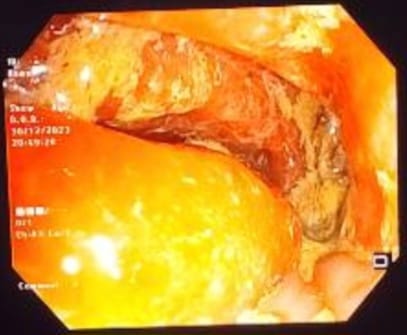
There was obstipation on the day before the surgical intervention. Conservative treatment started with intravenous fluid and antibiotics, and then an urgent sigmoidoscopy was performed. It showed apparent volvulus with dusky ischemic mucosa around it (Figure 2). An immediate referral to surgery by a gastroenterologist was made. Through midline incision, the intraoperative findings confirmed sigmoid volvulus which was resected, and then Hartmann's procedure was performed (Figure 3).

Follow-up
After three months of the operation, colostomy closure and colorectal re-anastomosis were performed. The patient was doing well and had normal physical status and vital signs.
Discussion
Intestinal volvulus is rarely encountered in the adolescent age group, with a few cases reported in recent years summarized in (Table 1) [2,4,7-13]. This condition requires the presence of a redundant, long, and mobile section of the intestine, coupled with a relatively narrow mesenteric attachment. This configuration leads to the fixation points at both ends of the intestinal segment being positioned close to each other, which facilitates the twisting or rotation of the segment. The sigmoid colon offers the perfect conditions for this twisting to happen. It can exhibit significant redundancy and mobility, with the fixation points at the lower part of the sigmoid and the junction where the sigmoid transitions into the rectum frequently situated close to one another. This elongated, redundant sigmoid colon with a tapered mesentery is called dolichosigmoid [14].
|
Author (year)reference |
No. Case |
Age (year) |
Sex |
PSH |
Presentation |
PHE/ CF |
Comorbidity |
Imaging findings |
Gangrene/ ischemia |
Management |
Follow-up (months) |
Recurrence |
|
Visalli et al. (2021)7 |
1 |
13 |
F |
No |
Constipation, Abd. Pain, LOA |
greatly distended, non-tender, and painless abdomen, without muscle guarding or rebounding tenderness |
Chronic Constipation |
SV |
No |
a water-soluble fluoroscopy guided contrast enema |
2 |
No |
|
Choi et al. (2020)8 |
1 |
16 |
M |
No |
vomiting, diarrhea, distension, Abd. pain |
abdominal distension with mild abdominal tenderness but without rebound tenderness, and a subtle metallic bowel sound. |
- |
SV |
No |
Rectal tube but recurrence occurred two times. definitive management by laparoscopic sigmoid colectomy |
9 |
Yes |
|
Esmat et al. (2020)9 |
1 |
19 |
M |
No |
Abd. pain, constipation, vomiting |
hypoactive bowel sounds, diffuse abdominal tenderness, and severe distention without guarding and rebound tenderness. |
- |
SV |
No |
a trans-rectal endoscopic detorsion, later anterior sigmoid resection and primary rectosigmoid anastomosis |
<1 |
Yes |
|
Godosis et al. (2020)10 |
1 |
10 |
M |
No |
Abd. pain, vomiting |
child appeared as a heavily sick patient, sweaty with weakness. His abdomen was flatulent in the two upper quadrants and totally flat and stiff in the two lower ones. Bowel sounds were absent |
- |
SV |
No |
A sigmoidectomy with a primary end to-end anastomosis of the descending colon with the upper rectum plus appendectomy were performed |
6 |
No |
|
Bhandari et al. (2019)4 |
1 |
14 |
M |
No |
Abd. Pain and distention, vomiting |
Signs of dehydration, gross Abd. distention, hyper-resonance with mild tenderness. Sluggish bowel sounds |
Constipation, developmental 3 delay, mental retardation |
SV |
No |
Lapartotomy, redundant sigmoid colon was resected after detortion and resection anastomosis was performed. |
<1 |
No |
|
Hassan et al. (2018)11 |
1 |
11 |
F |
No |
Abd. Pain and distention, vomiting, , and constipation |
Dehydrated, severely distended abdomen with diffuse tenderness, guarding, and tympanic to percussion with no shifting dullness. Sluggish bowel sounds. |
- |
SV |
Yes |
Hartmann's procedure was performed with a proximal end colostomy. |
<1 |
No |
|
Chang et al. (2017)12 |
1 |
12 |
M |
No |
Abd distention, nausea, poor appetite |
Massively distended abdomen. |
Autism |
SV |
No |
laparotomy with mesosigmoidoplasty for detorsion of the sigmoid |
3 |
No |
|
Emeka et al. (2022)2 |
1 |
14 |
M |
No |
Abd. Pain, vomiting |
Abd. distention, with marked tenderness in the suprapubic and both iliac fossae. Hyperactive bowel sounds. |
- |
SV |
No |
Sigmoidectomy with colorectal anastamosis |
<1 |
No |
|
Patel et al. (2014)13 |
1 |
14 |
F |
No |
abdominal distention, lower abdominal pain and absolute constipation |
abdomen was soft and diffusely distended and tympanic |
acquired microcephaly, central motor disorder severe learning disability, repetitive, chronic constipation and iron deficiency anaemia |
SV |
No |
emergency colonoscopic reduction and decompression followed by elective sigmoid colectomy |
6 |
No |
|
PHE/CF; Physical examination/clinical findings, Abd: abdominal, LOA: loss of appetite, PSH: past surgical history, SV: sigmoid volvulus |
||||||||||||
There is controversy regarding the development of dolichosigmoid. Some authors suggest that a congenitally long sigmoid colon, which lengthens over the years if a patient has chronic constipation, is the culprit of sigmoid volvulus. Proponents of this theory highlight that sigmoid volvulus tends to run in families, shows a higher prevalence in males, and exhibits a significant racial predisposition. They also note that certain tribes, such as the Pathans in Pakistan and Akambas in Kenya, show higher rates of this condition than their neighboring populations. Furthermore, the higher incidence sigmoid volvulus in Indians, who are studied to have a high incidence of dolichosigmoid in contrast to other ethnic groups, strengthens this side. Nevertheless, this congenital theory does not account for the rarity of the disorder in infants and children. Although dolichomegacolon can lead to chronic constipation and vice versa, the causal connection between the two remains unconfirmed. However, sigmoid volvulus in adolescents could favor the dolichomegacolon as the cause of chronic constipation. It is not likely for chronic constipation to cause such anatomical change from a young age, and it usually requires years before it manifests in adulthood. More studies specifically investigating these theories are still needed to establish this. [12-15]
Moreover, the differences in the frequency of sigmoid volvulus across various regions are thought to be associated with the consumption of a diet rich in fiber, particularly prevalent in Eastern regions. This high-fiber diet elongates both the sigmoid colon and its mesentery, creating a predisposed anatomical environment that makes it more susceptible to volvulize. In Western nations, where diets are characterized by low fiber content and high fat intake, colorectal cancer and diverticular disease emerge as the principal causes of colonic obstruction. For instance, in two of the cases in our review in the reported case by Visali et al. and Patel et al., who were 13 and 14 years old, respectively, they had a history of chronic constipation in line with that hypothesis; however, the current patient and the other cases in Table 1 did not complain or mention chronic constipation, which is suggestive of another pathophysiologic mechanism at play for patients in this age group [7,13,14].
The sigmoid colon can withstanding higher levels of intraluminal pressure compared to other segments of the large intestine, allowing the bowel wall to stay functional for several days. Nevertheless, heightened peristaltic activity in the proximal colon and increased fluid secretion lead to distension and elevated pressure within the volvulated segment. Bacterial fermentation further contributes to gas accumulation within the obstructed loop, exacerbating the swelling and raising the intraluminal pressure. If not salvaged in time, this increased pressure leads to vascular compromise and eventual ischemia and necrosis. This explains the severe distention reported by Esmat et al., 19-year-old male, who presented with abdominal pain, constipation, and vomiting for four days, which is enough time for colonic fluid secretion and bacterial fermentation in the volvulus to cause the severe distention of the patient complained of. However, what sets the current patient apart is the lack of abdominal distention and only moderate pain despite the onset of the symptoms for three days. What is more striking is that the patient was found to have dusky ischemia on sigmoidoscopy requiring urgent operative management. Furthermore, Hassan et al. described a case involving an 11-year-old patient who was discovered to have a severely swollen, dark, gangrenous sigmoid with a narrow mesentery and thrombosis of the vessels. This case underscores the severity and seriousness of the condition, particularly in adolescents, where it is less commonly included in the differential diagnosis [9, 11, 14].
It is essential to highlight that for the twist to result in a clinically relevant obstruction, it must exceed 180°. Twists less than 180° are considered physiological volvulus and typically do not have a significant clinical impact. In contrast, a torsion that causes lumen obstruction and exceeds 180° is classified as obstructive volvulus. When the torsion surpasses 360°, it is called strangulating volvulus. There is frequently a notable delay, averaging between 3 to 4 days, from the onset of sigmoid volvulus to its evaluation. Due to the often severe and rapid onset of symptoms associated with endemic sigmoid volvulus, patients typically present with signs indicative of an acute abdomen. These symptoms commonly include abdominal tenderness, severe pain, early onset of vomiting, bloody stools, and, in severe cases, hemodynamic instability. In chronic or indolent sigmoid volvulus, there may be partial obstruction of the sigmoid colon that allows for the passage of liquid stools, leading to the paradoxical occurrence of diarrhea. In the present case, although the patient reported diarrhea, suggestive of potential partial obstruction, the diagnostic evaluation revealed strangulation with impaired blood flow. Additionally, it is crucial to recognize that in pediatric cases, sigmoid volvulus often presents as repeated abdominal pain and hematochezia, which could be erroneously diagnosed as ischemic colitis or irritable bowel syndrome [7,12-15].
In 60 to 75 percent of sigmoid volvulus cases, a simple plain abdominal radiograph is often needed to confirm the diagnosis. These radiographs usually reveal dramatic colonic distension, sometimes accompanied by slight bowel enlargement. When the radiographs are inconclusive, a contrast enema can provide crucial diagnostic insights, proving particularly effective in children compared to adults. For instance, in the case of Visali et al., the contrast enema not only diagnosed but also resolved the volvulus without surgical intervention. Remarkably, the patient experienced no recurrence of symptoms throughout a two-month follow-up period. Computed tomography scans and magnetic resonance imaging offer nearly 100 percent diagnostic accuracy for sigmoid volvulus. Despite this high accuracy, their application is constrained by limited availability in endemic regions. Both imaging modalities effectively reveal the twisted pedicle of sigmoid volvulus as a characteristic whorled soft tissue mass. Endoscopy serves both diagnostic and therapeutic roles in managing sigmoid volvulus. The occurrence of mucosal spirals and blockage within the lumen at the rectosigmoid junction observed during endoscopy is considered pathognomonic for sigmoid volvulus. However, up to 15% of SV cases are typically identified only during laparotomy or post-mortem examination. Entities that could present similarly to sigmoid volvulus include neoplasms of the colon, colonic megacolon resulting from irregular motility, toxic megacolon, and ileosigmoid knotting [5-8, 14].
Management approaches for sigmoid volvulus focus on relieving the obstruction and preventing recurrence. The standard elective surgical approach is sigmoid resection with primary anastomosis. This procedure is performed through open laparotomy or laparoscopic methods, provided the large intestine can be adequately decompressed. Individuals who are effectively decompressed via endoscopy before ultimate resection have a recurrence rate approaching 0% [14].
Emergency resection and primary anastomosis are recommended if decompression is deemed unfeasible or when clinical signs indicate peritonitis or colonic ischemia. Intestinal ischemia signs include gangrenous mucosa observed while attempting decompression, bloody stool, increased body temperature and white blood cells, abdominal tenderness, and hemodynamic instability. In these scenarios, immediate patient resuscitation is essential, followed by exploration through a midline laparotomy. If the bowel is viable during laparotomy, the volvulus should be manually reduced and the twisted sigmoid colon resected. However, if a gangrenous bowel is found, detorsion should be avoided. Performing detorsion in the presence of gangrene risks releasing accumulated toxins and bacteria into the bloodstream, potentially leading to sepsis and cardiovascular collapse. [13-15]
In a review of 63 cases by Salas et al. involving children and adolescents with sigmoid volvulus, 49 patients received operative treatment, with sigmoidectomy (with or without primary anastomosis) being the predominant procedure. The total mortality rate was 6%, with an operative mortality rate of 8.1% and a neonatal mortality rate of 14%. [15].
Conclusion
Strangulated Sigmoid volvulus should be considered in adolescents with abdominal pain despite having diarrhea and no clinically evident abdominal distention. Hartman’s procedure may result in a good outcome.
Declarations
Conflicts of interest: The authors have no conflicts of interest to disclose.
Ethical approval: Not applicable.
Patient consent (participation and publication): Written informed consent was obtained from the patient for publication.
Funding: The present study received no financial support.
Acknowledgements: None to be declared.
Authors' contributions: DTG and DAM were significant contributors to the conception of the study and the literature search for related studies. OOQ was the radiologist who performed the assessment of the case. DH was involved in the literature review, study design, and manuscript writing. AAA, KFH, DAI, HHK, and HOA were involved in the literature review, the study's design, and the critical revision of the manuscript, and they participated in data collection. DH and DTG confirm the authenticity of all the raw data. All authors approved the final version of the manuscript.
Use of AI: ChatGPT version 5.2 (OpenAI) was used solely for language editing, paraphrasing, and improvement of clarity and grammar in this manuscript. The artificial intelligence tool did not contribute to the study design, data collection, data analysis, data interpretation, or the generation of scientific content. All outputs produced with the assistance of ChatGPT were carefully reviewed, verified, and approved by the authors. The authors take full responsibility for the accuracy, integrity, and originality of the entire manuscript.
Data availability statement: The datasets used and/or analyzed during the current study are available from the corresponding author upon reasonable request.
References
- Sadler TW. Langman's medical embryology. Lippincott Williams & Wilkins; 2022. doi:N/A
- Emeka CK. Sigmoid volvulus in a teenager. Journal of Pediatric Surgery Case Reports. 2022;76:102119. doi:10.1016/j.epsc.2021.102119
- Atamanalp SS. Sigmoid volvulus. The Eurasian journal of medicine. 2010;42(3):142. doi:10.5152/eajm.2010.39
- Bhandari TR, Shahi S. Volvulus of sigmoid colon in a challenged adolescent: An unusual case report. Annals of Medicine and Surgery. 2019;44:26-8. doi:10.1016/j.amsu.2019.06.009
- Prasad S, Nassar M, Azzam AY, García-Muro-San José F, Jamee M, Sliman RK, et al. CaReL Guidelines: A Consensus-Based Guideline on Case Reports and Literature Review (CaReL). Barw Med J. 2024;2(2):13-19. doi:10.58742/bmj.v2i2.89
- Abdullah HO, Abdalla BA, Kakamad FH, Ahmed JO, Baba HO, Hassan MN, et al. Predatory Publishing Lists: A Review on the Ongoing Battle Against Fraudulent Actions. Barw Medical Journal. 2024;2(2):26-30. doi:10.58742/bmj.v2i2.91
- Visalli C, Trimarchi R, Spatola A, Miano SM, Salamone I. Non-invasive treatment of the sigmoid volvulus. A pediatric case report. Radiology Case Reports. 2021;16(9):2429-33. doi:10.1093/jscr/rjad166
- Choi SY, Kim KH. Recurrent Attacks of Sigmoid Volvulus in a 16-Year-Old Boy: A Case Report. Advances in Pediatric Surgery. 2020;26(1):28-32. doi:10.13029/aps.2020.26.1.28
- Esmat HA. Sigmoid volvulus in a teenager, successfully managed with endoscopic detorsion: An unusual case report and review of the literature. International Journal of Surgery Case Reports. 2020;77:875-9. doi:10.1016/j.ijscr.2020.11.152
- Godosis D, Kepertis C, Demiri C, Lambropoulos V, Spyridakis I. Sigmoid volvulus in a 10-year-old male: A case report and review of the literature. Pediatric Reports. 2020;12(1):8476. doi:10.4081/pr.2020.8476
- Hassan AH. A case report about gangrenous sigmoid volvulus in 11-year-old girl. Journal of pediatric surgery case reports. 2018;31:29-31. doi:10.1016/j.epsc.2017.12.002
- Chang PH, Jeng CM, Chen DF, Lin LH. A case report and literature review of sigmoid volvulus in children. Medicine. 2017;96(52):e9434. doi:10.1097/md.0000000000009434
- Patel RV, Njere I, Campbell A, Daniel R, Azaz A, Fleet M. Sigmoid volvulus in an adolescent girl: staged management with emergency colonoscopic reduction and decompression followed by elective sigmoid colectomy. Case Reports. 2014;2014:bcr2014206003. doi:10.1136/bcr-2014-206003
- Osiro SB, Cunningham D, Shoja MM, Tubbs RS, Gielecki J, Loukas M. Article commentary: The twisted colon: A review of sigmoid volvulus. The American Surgeon. 2012;78(3):271-9. doi:10.1177/000313481207800331
- Salas S, Angel CA, Salas N, Murillo C, Swischuk L. Sigmoid volvulus in children and adolescents. Journal of the American College of Surgeons. 2000;190(6):717-23. doi:10.1097/IO9.0000000000000337

This work is licensed under a Creative Commons Attribution 4.0 International License.