
Resistance Patterns of Gram-Negative Bacteria and Surgical Site Infections Across the Middle East: A Systematic Review and Meta-Analysis

Abstract
Introduction
Surgical site infections (SSIs) are a leading healthcare-associated infection, driven by multidrug-resistant Gram-negative bacteria. Regional data from the Middle East remain limited. This meta-analysis aimed to estimate pooled antimicrobial resistance (AMR) profiles of Gram-negative isolates (GNI) recovered from SSIs.
Methods
PubMed/MEDLINE and Google Scholar were searched in January 2026 for studies reporting AMR in SSI GNI. Eligible studies were English-language reports from the Middle East presenting AMR patterns of Gram-negative bacteria recovered from SSIs. Case reports, laboratory and animal studies, conference papers, and abstract-only publications were ineligible. Proportions were pooled using DerSimonian-Laird random-effects models with Freeman-Tukey double-arcsine transformation, heterogeneity assessed by I².
Results
Twenty-three studies from 8 countries were included. GNI comprised 71.9% (95% CI 60.5-82.2) of all culture-positive isolates and, when restricted to SSI-confirmed specimens, 86.4% (95% CI 63.6-99.3). Escherichia coli was most frequent (27.9%), followed by Pseudomonas aeruginosa (25.8%) and Klebsiella pneumoniae (21.3%). Resistance exceeded 65% for ampicillin in E. coli and for ceftriaxone in both E. coli and K. pneumoniae, with resistance to the remaining third-generation cephalosporins (cefotaxime, ceftazidime) ranging from 46.5% to 85.9%.
Conclusion
Gram-negative SSI isolates in the Middle East showed high resistance across many agent classes, with substantial multidrug resistance, carbapenem resistance, and ESBL production. This regional resistance profile reinforces the need for local, SSI-specific surveillance and antimicrobial stewardship.
Introduction
Surgical site infections (SSIs) are among the most frequent and challenging complications following surgical procedures, significantly impacting patient outcomes, hospital costs, and quality of care worldwide. They are the most frequent healthcare-associated infection in low- and middle-income countries (LMICs) [1]. The proportion of SSIs is reported to be up to 27% of healthcare-associated infections in LMICs [2]. The pooled incidence of SSIs in LMICs is reported to be 5.9 per 100 surgical operations and 11.2 per 100 surgical patients, with rates reaching 11.7% after caesarean section [1].
Even though SSIs were historically dominated by Gram-positive organisms, current epidemiological data show the emergence of multidrug-resistant Gram-negative bacteria (MDR-GNB), which is clinically significant in various healthcare settings. The most commonly reported GNBs were Escherichia coli, Klebsiella pneumoniae, Acinetobacter baumannii, Pseudomonas aeruginosa, and Enterobacter spp. [3].
Despite the use of perioperative antibiotics, SSIs continue to burden postoperative patients, a problem attributed to the emergence of antimicrobial resistance (AMR) [4]. Globally, AMR is a dire health threat [4]. It is estimated to be responsible for approximately five million deaths annually [5]. In the United States, a significant number of pathogens contributing to the SSI were reported to be resistant to standard prophylactic antibiotics [6]. The problem of AMR is particularly pronounced in developing countries [7]. To address this threat, the World Health Organization (WHO) prioritizes antibiotic-resistant bacteria to guide research and control strategies. In its 2024 Bacterial Priority Pathogens List, GNB dominate the critical tier [8].
Despite this global attention, robust regional data regarding resistance patterns in SSI from the Middle East remain scarce [6]. Continuous surveillance is therefore needed and requires a systematic approach that accounts for patient-, procedure-, and environment-related risk factors [9].
This systematic review and meta-analysis aimed to estimate the regional pooled antibiotic-resistance profiles of Gram-negative isolates (GNI) recovered from SSI.
Methods
Study Protocol
This systematic review and meta-analysis study was conducted in compliance with the Preferred Reporting Items for Systematic Reviews and Meta-Analyses (PRISMA) 2020 statement guidelines.
Data Sources and Search Strategy
A comprehensive systematic search was conducted in PubMed/MEDLINE and Google Scholar in January 2026 to identify published studies reporting antibiotic resistance patterns of GNI from SSIs in the Middle East. The search strings were as follows. PubMed/MEDLINE: ("Antimicrobial Resistance"[tiab] OR "Antibiotic Resistance"[tiab] OR MDR[tiab] OR "multidrug-resistant"[tiab]) AND ("Surgical Wound Infection"[Mesh] OR "Surgical Site Infection"[ti] OR SSI[ti] OR "Postoperative Wound Infection"[ti]) AND ("Gram-Negative Bacteria"[Mesh] OR Enterobacteriaceae[tiab] OR "Escherichia coli"[tiab] OR "Klebsiella pneumoniae"[tiab] OR "Pseudomonas aeruginosa"[tiab] OR "Acinetobacter baumannii"[tiab]). Google Scholar: allintitle: "Gram negative" OR Enterobacteriaceae OR "Escherichia coli" OR "E coli" OR Klebsiella OR Pseudomonas OR Acinetobacter "Wound Infection" OR "Surgical Wound Infection" OR "Surgical Site Infection". Manual citation searching of all retrieved articles was performed for additional relevant studies.
Eligibility Criteria
Studies were included if: (1) they were published in English; (2) reported human clinical samples of GNI recovered from SSIs; (3) reported AMR patterns for SSI GNI; (4) were conducted in the Middle East, which for this review was defined as the transcontinental region comprising the Arabian Peninsula, the Levant, Iraq, Iran, Türkiye, and Egypt; and (5) for studies that sampled mixed clinical specimens, SSI-specific isolates and their antimicrobial-susceptibility data could be extracted separately.
Studies were excluded if they: (1) had insufficient data on bacterial species identification, antimicrobial susceptibility testing, or confirmation of SSI; (2) were case reports, in vitro or animal studies, or conference papers; (3) were abstract-only publications; or (4) were in non-recommended journals/publishers [10].
Study Selection Process
Two reviewers independently screened the titles and abstracts of all studies to identify studies meeting the eligibility criteria. Retrieved eligible articles underwent full-text review by both reviewers. A third reviewer was enlisted to cast the deciding vote and resolve discrepancies by evaluating conflicting data and reaching a consensus. Duplicate records were removed manually.
Data-Collection Process
Two reviewers independently extracted data using a structured Microsoft Excel spreadsheet. Discrepancies in extracted data were resolved by consulting a third reviewer. Data extracted from eligible studies included: (1) study characteristics (first author, year of publication, country, study design, study period, and sample size); (2) patient characteristics included demographic variables (age, sex), type of surgery, surgical urgency (elective and emergency), surgical wound classification (clean, clean contaminated, contaminated, dirty), and SSI classification (superficial incisional, deep incisional, organ/space); (3) microbiological profile included total clinical sample counts, culture-positive isolate counts, microbial growth patterns (monomicrobial and polymicrobial), the total number of Gram-negative isolates (GNI), and the number of GNI recovered specifically from SSIs (SSI-specific GNI, i.e., defined by specimen source rather than by species); (4) susceptibility of antimicrobials for SSI-specific GNI across the following antibiotic classes: aminoglycosides (gentamicin, amikacin), carbapenems (imipenem, meropenem), cephalosporins (cefotaxime, ceftazidime, ceftriaxone, cefepime, cefoxitin, cefuroxime), fluoroquinolones (ciprofloxacin, levofloxacin), folate pathway inhibitors (co-trimoxazole), beta-lactam beta-lactamase inhibitors (ampicillin/sulbactam, piperacillin/tazobactam, amoxicillin/clavulanate), penicillins (ampicillin) and monobactams (aztreonam); and (5) antibiotic resistance patterns: MDR, extended-spectrum beta-lactamase (ESBL) and carbapenem resistance (CR). For studies reporting mixed clinical specimens, only data that could be specifically attributed to surgical site infections were extracted for SSI-specific resistance analyses.
Outcomes
The primary outcome was the AMR profile of GNI recovered from SSIs. For each species, this comprised the pooled proportion of resistance to each individual antimicrobial agent, together with the pooled proportions of isolates classified as MDR, CR, and ESBL-producing.
Secondary outcomes were (i) the pooled proportion of GNI among all culture-positive isolates recovered by the included studies (the all-isolate denominator), (ii) the pooled proportion of GNI among isolates confirmed to derive from SSIs (the SSI-restricted denominator), and (iii) the pooled prevalence of each individual species among SSI GNI. These outcomes characterize the organisms that underlie the resistance estimates.
Pooled proportions of MDR, CR, and ESBL production were analyzed only when these categories were classified and reported by the primary studies themselves; they were not derived from agent-level resistance percentages. Accordingly, the number of studies and isolates contributing to the MDR, CR, and ESBL estimates may differ from those contributing to agent-level resistance estimates.
Quality Assessment
Methodological quality was appraised using design-specific Joanna Briggs Institute critical appraisal checklists [11]. Studies were assessed using the checklist corresponding to their design: cross-sectional (8 items), case-control (10 items), cohort (11 items), or case series (10 items). These appraisals informed the risk-of-bias domain of the Grading of Recommendations Assessment, Development and Evaluation (GRADE) certainty assessment.
Data Analysis
Data were analyzed using the meta package in R version 4.6.0. Proportions were pooled using a DerSimonian-Laird random-effects model with the Freeman-Tukey double-arcsine transformation to stabilize variances and to accommodate studies reporting proportions of 0% or 100%.
Each bacterium-antibiotic combination (and likewise each species and resistance-pattern outcome) was pooled only when at least two studies contributed data. Between-study heterogeneity was assessed using Cochran’s Q test and quantified using the I² statistic and the between-study variance (τ²). Each species-level prevalence was pooled independently across its own set of contributing studies; the resulting estimates are therefore not mutually exclusive partitions of a common denominator and are not expected to sum to 100%.
To explore geographical variation, resistance was further analyzed in subgroups by country. A formal between-country comparison (Cochran’s Q test between subgroups) was performed only when at least two countries each contributed at least two studies, and the corresponding p-value is reported for these analyses.
Temporal trends were explored using random-effects meta-regression of the logit-transformed proportion of resistance on publication year for each bacterium-antibiotic combination. As sampling periods were inconsistently reported, publication year served as a proxy for collection year. These regressions are reported as the odds ratio for resistance per year with 95% confidence intervals, and were carried out only for combinations with at least six studies; significant trends (p < 0.05) were confirmed by leave-one-out analysis and considered robust only if significance persisted after removal of any single study.
Certainty of Evidence
The certainty of evidence for each pooled estimate was rated with the GRADE approach adapted for prevalence data [12]. As all included studies were observational, every outcome began at low certainty and was rated down for risk of bias, inconsistency, indirectness, imprecision, and publication bias. Inconsistency was judged from the I² statistic, imprecision from the width of the pooled confidence interval and the number of contributing isolates, and risk of bias from the JBI appraisal; publication bias could not be formally assessed.
Results
Study Selection
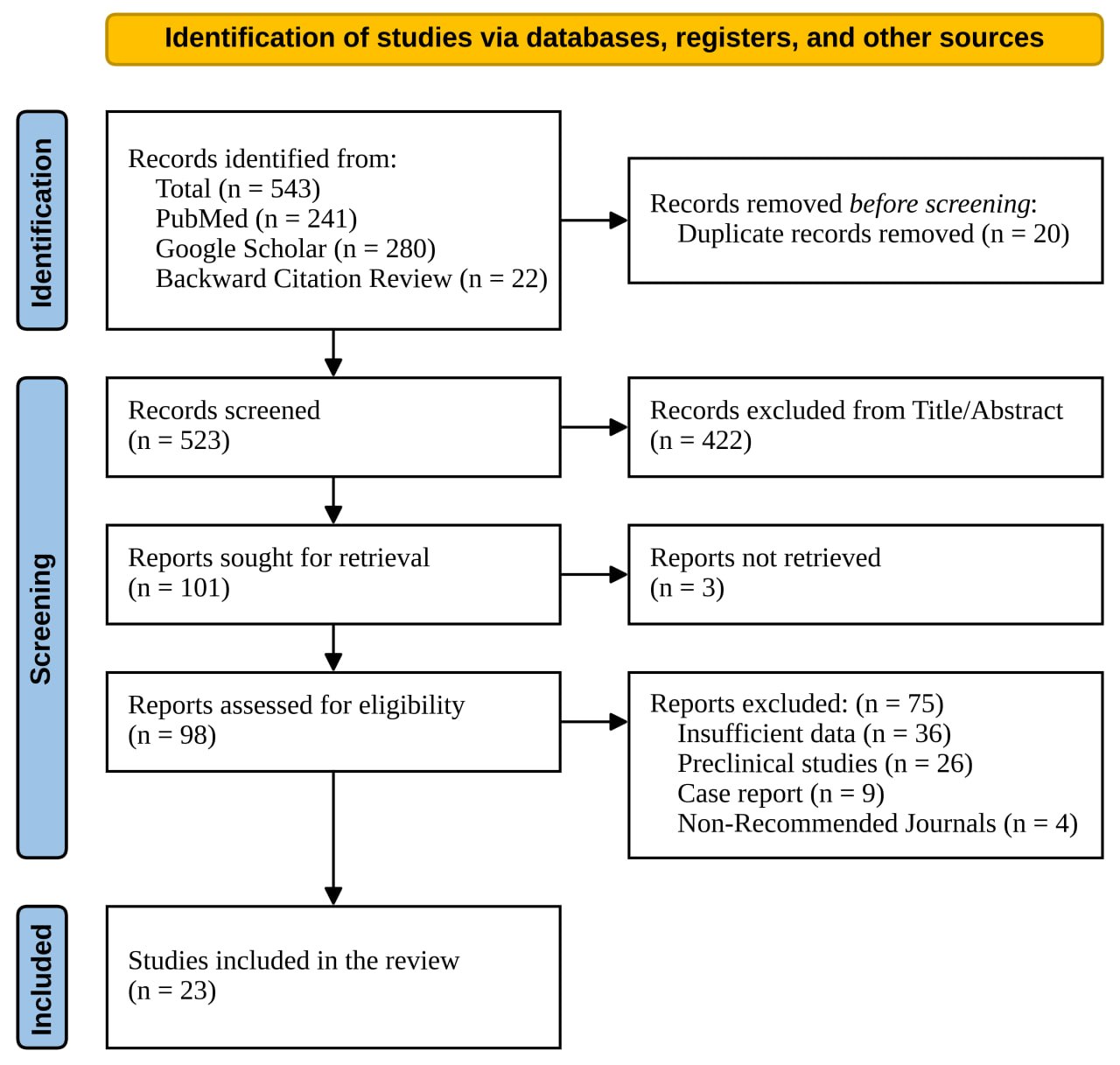
A total of 543 records were identified through electronic searches (PubMed/MEDLINE and Google Scholar) and backward citation searching. After 20 duplicates were removed, 523 records underwent title and abstract screening, of which 422 were excluded.
The remaining 101 reports were sought for retrieval; 3 could not be retrieved. The 98 reports assessed for eligibility underwent full-text screening, after which 75 were excluded, leaving 23 included studies (Figure 1) [6,9,13–33].
Study and Patient Characteristics
The included studies were published between 2005 and 2026. They were conducted across 8 countries, most frequently Egypt (n = 6), Iraq (n = 4), Türkiye (n = 4), Iran (n = 3), and Saudi Arabia (n = 3). Most included studies were cross-sectional in design (n = 17), followed by prospective cohort studies (n = 3), case-control studies (n = 2), and one case series. Study duration varied and ranged from 4 to 120 months. The combined sample comprised 5,413 patients.
Sex distribution was reported for 3,694 patients, with 1,866 males (50.51%) and 1,828 females (49.49%). Patient age was reported with a pooled weighted mean of 44.57 (SD 20.32). Seventeen studies (n = 4,027; 74.39%) sampled SSIs exclusively, while six (n = 1,386; 25.61%) included mixed clinical specimens (Table 1 & Table 2). Methodological quality, assessed using the Joanna Briggs Institute critical appraisal checklist, was generally good across the four designs (Table S1).
|
Author(s) |
Ref |
Year |
Country |
Study Design |
Duration (months) |
Age (Mean ± SD) |
Sample size |
Male |
Female |
Hospital stays (d) |
Infection type |
JBI |
|
Kawtharani et al. |
[25] |
2026 |
Lebanon |
Cross-sectional |
9 |
57.0 ± 21 |
63 |
23 |
40 |
N/A |
SSI |
8/8 |
|
Ramadan et al. |
[13] |
2025 |
Egypt |
Cross-sectional |
6 |
42.0 ± 14.2 |
130 |
76 |
54 |
N/A |
SSI |
6/8 |
|
Anwar et al. |
[17] |
2025 |
Iraq |
Cross-sectional |
12 |
50.1 ± 20.7 |
128 |
67 |
61 |
4 |
Mixed Clinical |
5/8 |
|
Muhammed et al. |
[23] |
2024 |
Iraq |
Cross-sectional |
6 |
41.7 ± 18.8 |
61 |
31 |
30 |
N/A |
SSI |
7/8 |
|
Alruways et al. |
[22] |
2023 |
Saudi Arabia |
Cross-sectional |
12 |
N/A |
31 |
21 |
10 |
N/A |
Mixed Clinical |
6/8 |
|
Heidari et al. |
[14] |
2022 |
Iran |
Cross-sectional |
6 |
N/A |
115 |
63 |
52 |
N/A |
Mixed Clinical |
8/8 |
|
Elnagar |
[16] |
2021 |
Egypt |
Cross-sectional |
12 |
49.2 ± 13 |
186 |
117 |
69 |
6.7 |
SSI |
7/8 |
|
Ali and Al-Jaff |
[28] |
2021 |
Iraq |
Cross-sectional |
12 |
N/A |
133** |
49 |
64 |
N/A |
SSI |
7/8 |
|
Hemmati et al. |
[33] |
2020 |
Iran |
Cross-sectional |
24 |
49.0 ± 19.6 |
78 |
54 |
24 |
16.6 |
SSI |
5/8 |
|
El-Saed et al. |
[6] |
2020 |
Saudi Arabia |
Cross-sectional |
120 |
49.5 ± 18 |
403* |
120 |
280 |
N/A |
SSI |
6/8 |
|
Raouf et al. |
[30] |
2020 |
Egypt |
Prospective Cohort |
24 |
40.9 ± 13.1 |
57 |
27 |
30 |
12.6 |
SSI |
5/11 |
|
Metwally and Aamir |
[26] |
2020 |
Egypt |
Cross-sectional |
10 |
42.0 ± 13 |
135 |
84 |
51 |
7.7 |
SSI |
7/8 |
|
Abdulqader and Saadi |
[31] |
2019 |
Iraq |
Prospective Cohort |
6 |
45.8 ± 15.2 |
31 |
20 |
11 |
1.87 |
SSI |
8/11 |
|
El-Kholy et al. |
[18] |
2018 |
Egypt |
Case-control |
12 |
51.0 ± 21.7 |
33 |
24 |
9 |
13 |
SSI |
9/10 |
|
Al-Awaysheh |
[9] |
2018 |
Jordan |
Cross-sectional |
12 |
55.1 ± 10 |
102 |
47 |
55 |
N/A |
SSI |
7/8 |
|
Nasiri et al. |
[19] |
2018 |
Iran |
Cross-sectional |
N/A |
43.0 ± 22.1 |
369 |
164 |
205 |
19.9 |
Mixed Clinical |
7/8 |
|
Helal et al. |
[32] |
2015 |
Egypt |
Cross-sectional |
N/A |
N/A |
100 |
N/A |
N/A |
≥7.0 |
SSI |
7/8 |
|
Namıduru et al. |
[24] |
2013 |
Türkiye |
Prospective Cohort |
4 |
40.6 ± 22.4 |
1,397 |
706 |
691 |
17.9 |
SSI |
3/11 |
|
Khan et al. |
[20] |
2012 |
Qatar |
Case series |
24 |
44.0 ± 14.7 |
6 |
5 |
1 |
N/A |
SSI |
10/10 |
|
Khairy et al. |
[29] |
2011 |
Saudi Arabia |
Cross-sectional |
9 |
45.4 ± 12.7 |
131 |
93 |
38 |
N/A |
SSI |
8/8 |
|
Bayram and Balci |
[21] |
2006 |
Türkiye |
Cross-sectional |
12 |
N/A |
615 |
N/A |
N/A |
N/A |
Mixed Clinical |
6/8 |
|
Akıncı et al. |
[27] |
2005 |
Türkiye |
Case-control |
9 |
53.1 ± 20.8 |
128 |
75 |
53 |
19.5 |
Mixed Clinical |
9/10 |
|
Surucuoglu et al. |
[15] |
2005 |
Türkiye |
Cross-sectional |
60 |
N/A |
981 |
N/A |
N/A |
N/A |
SSI |
7/8 |
|
*Sex reported for 400 patients. **Sex reported for 113 patients. Abbreviations: N/A, not reported. JBI, Joanna Briggs Institute critical appraisal score. |
||||||||||||
|
Variable |
Total no. (%) |
|
Patients |
5,413 (100.00%) |
|
Mean Age |
44.57 a |
|
Male |
1,866 (50.51%) b |
|
Female |
1,828 (49.49%) b |
|
Isolate Source |
5,413 (100.00%) |
|
SSI |
4,027 (74.39%) |
|
Mixed Clinical |
1,386 (25.61%) |
|
Surgical Wound Classification |
2,523 (100.00%) c |
|
Clean-contaminated |
1,602 (63.50%) |
|
Clean |
490 (19.42%) |
|
Contaminated |
331 (13.12%) |
|
Dirty |
100 (3.96%) |
|
SSI Classification |
998 (100.00%) c |
|
Superficial incisional |
613 (61.42%) |
|
Deep incisional |
330 (33.07%) |
|
Organ-Space |
55 (5.51%) |
|
Surgical Urgency |
698 (100.00%) c |
|
Emergency Surgery |
411 (58.88%) |
|
Elective Surgery |
287 (41.12%) |
|
Types Of Surgery |
2,130 (100.00%) c |
|
General/Gastrointestinal Surgery |
774 (36.34%) |
|
Orthopedic |
445 (20.89%) |
|
Obstetrics/Gynecology |
271 (12.72%) |
|
Cardiovascular & Thoracic |
225 (10.56%) |
|
Pediatric surgery |
65 (3.05%) |
|
Neurosurgery |
39 (1.83%) |
|
Plastic surgery |
35 (1.64%) |
|
Urological surgery |
12 (0.56%) |
|
Other/unspecified |
264 (12.39%) |
|
Microbial Growth Pattern |
312 (100.00%) c |
|
Monomicrobial |
188 (60.26%) |
|
Polymicrobial |
124 (39.74%) |
|
Susceptibility Test Method |
23 (100.00%) |
|
Disc Diffusion |
19 (82.61%) |
|
Automated systems (VITEK) |
2 (8.70%) |
|
Mixed methods |
2 (8.70%) |
|
Microbial Profile among GNB Isolates |
2,122 (100.00%) c |
|
Pseudomonas aeruginosa |
637 (30.02%) |
|
Escherichia coli |
480 (22.62%) |
|
Klebsiella pneumoniae |
375 (17.67%) |
|
Acinetobacter baumannii |
269 (12.68%) |
|
Enterobacter species |
161 (7.59%) |
|
Proteus mirabilis |
109 (5.14%) |
|
Citrobacter species |
25 (1.18%) |
|
Other gram negatives** |
66 (3.11%) |
|
SSI Gram-Negative Bacteria Isolates |
1,322 (62.30%) |
|
Non-SSI Gram-Negative Bacteria Isolates |
800 (37.70%) |
|
Microbial Profile among SSI GNB Isolates |
1,322 (100.00%) c d |
|
Escherichia coli |
332 (25.11%) |
|
Pseudomonas aeruginosa |
320 (24.21%) |
|
Klebsiella pneumoniae |
280 (21.18%) |
|
Acinetobacter baumannii |
113 (8.55%) |
|
Enterobacter species |
99 (7.49%) |
|
Proteus mirabilis |
90 (6.81%) |
|
Citrobacter species |
23 (1.74%) |
|
Other gram negatives** |
65 (4.92%) |
|
*Percentages may not add up to 100 due to rounding. **Other GNB isolates include Stenotrophomonas maltophilia: Serratia spp.: Providencia spp.: Salmonella Typhimurium: Burkholderia cepacia: Morganella morganii: Bacteroides fragilis: Proteus vulgaris. a: Number reported is pooled weighted mean across 17 studies. b: Sex distribution was reported in 20 studies (n = 3,694). c: Totals for each section correspond to the number of relevant cases and isolates. d: This total is a crude count of all Gram-negative isolates. Species prevalences are pooled estimates drawn only from studies reporting each species, so their denominators are study-dependent and lower than this total. Abbreviations: SSI, Surgical site infection; GNB, Gram-negative bacteria. |
|
Surgical Wound and Procedure Characteristics
The majority of surgical wounds were clean-contaminated, 1,602 (63.50%), followed by clean, 490 (19.42%), contaminated, 331 (13.12%), and dirty, 100 (3.96%). The three most frequent surgery types were general/gastrointestinal surgery, 774 (36.34%), orthopedic surgery, 445 (20.89%), and obstetrics/gynecology, 271 (12.72%). A large proportion of the SSIs were superficial incisional, 613 (61.42%), followed by deep incisional, 330 (33.07%), and organ-space, 55 (5.51%). Microbial growth patterns were monomicrobial in 188 (60.26%) and polymicrobial in 124 (39.74%). The most common susceptibility test method was disc diffusion, 19 (82.61%) (Table 2).
Main Outcomes
Antimicrobial Resistance Estimates
Cefoxitin demonstrated the peak pooled resistance in E. coli at 82.4% (95% CI 41.5-100.0), with ampicillin-sulbactam recording the next highest at 74.8% (95% CI 48.1-93.9). K. pneumoniae isolates showed the highest resistance to cefoxitin at 88.3% (95% CI 64.7-99.6), closely trailed by cefotaxime at 85.9% (95% CI 65.1-98.1). Among clinically relevant anti-pseudomonal agents, the greatest resistance level for P. aeruginosa was observed against ceftazidime, 59.1% (95% CI 33.7-82.0), followed by gentamicin, 46.7% (95% CI 28.5-65.3). Among clinically relevant agents, A. baumannii showed the highest resistance to cefepime at 84.9% (95% CI 70.2-95.2), followed by ampicillin-sulbactam at 84.2% (95% CI 55.5-99.2). Among the antibiotics tested against P. mirabilis, ciprofloxacin yielded the top resistance rate of 45.8% (95% CI 15.7-77.6), followed by ceftazidime, 44.9% (95% CI 10.4-82.6). Finally, Enterobacter spp. exhibited a top pooled resistance of 52.0% to ceftazidime (95% CI 23.2-80.1) and a subsequent 49.6% to ciprofloxacin (95% CI 21.9-77.3). Resistance to imipenem and meropenem was 13.9% (95% CI 4.3-27.7) and 7.7% (95% CI 1.2-18.8) in E. coli, 22.2% (95% CI 9.8-37.9) and 23.3% (95% CI 9.6-40.8) in K. pneumoniae, and 34.1% (95% CI 16.0-54.9) and 31.7% (95% CI 14.0-52.6) in P. aeruginosa (Table 3).
|
Antibiotic drug |
Resistant (n) |
Sample (n) |
Pooled resistance (%) * |
95% CI |
I2 (%) |
P-value** |
|
Escherichia coli |
||||||
|
Amikacin |
36 |
139 |
25.6 |
4.1 - 57.3 |
93.2 |
<0.001 |
|
Gentamicin |
68 |
183 |
42.9 |
21.4 - 65.9 |
89.9 |
<0.001 |
|
Imipenem |
20 |
158 |
13.9 |
4.3 - 27.7 |
77.9 |
<0.001 |
|
Meropenem |
13 |
161 |
7.7 |
1.2 - 18.8 |
77.3 |
<0.001 |
|
Cefuroxime |
31 |
83 |
54.2 |
6.3 - 97.1 |
95.7 |
<0.001 |
|
Cefepime |
42 |
60 |
73.9 |
35.6 - 98.0 |
89.7 |
<0.001 |
|
Cefotaxime |
35 |
78 |
46.5 |
26.5 - 67.1 |
71.9 |
0.014 |
|
Ceftazidime |
51 |
111 |
67.4 |
20.8 - 98.6 |
96.0 |
<0.001 |
|
Ceftriaxone |
42 |
59 |
73.8 |
56.2 - 88.1 |
50.4 |
0.109 |
|
Cefoxitin |
36 |
45 |
82.4 |
41.5 - 100.0 |
89.1 |
<0.001 |
|
Ciprofloxacin |
57 |
91 |
69.8 |
44.0 - 90.3 |
84.6 |
<0.001 |
|
Levofloxacin |
26 |
48 |
64.9 |
26.6 - 94.4 |
87.2 |
<0.001 |
|
Co-trimoxazole |
65 |
129 |
52.7 |
39.5 - 65.8 |
52.9 |
0.060 |
|
Aztreonam |
19 |
92 |
38.8 |
7.9 - 76.1 |
91.3 |
<0.001 |
|
Amoxicillin-clavulanate |
55 |
126 |
55.3 |
33.5 - 76.1 |
82.2 |
<0.001 |
|
Ampicillin-sulbactam |
34 |
45 |
74.8 |
48.1 - 93.9 |
68.9 |
0.040 |
|
Piperacillin-tazobactam |
5 |
62 |
16.2 |
0.0 - 80.7 |
94.4 |
<0.001 |
|
Ampicillin |
65 |
117 |
71.2 |
36.8 - 95.5 |
92.4 |
<0.001 |
|
Klebsiella pneumoniae |
||||||
|
Amikacin |
57 |
125 |
31.4 |
9.0 - 59.7 |
90.1 |
<0.001 |
|
Gentamicin |
66 |
127 |
49.6 |
26.1 - 73.2 |
86.1 |
<0.001 |
|
Imipenem |
31 |
125 |
22.2 |
9.8 - 37.9 |
71.1 |
0.001 |
|
Meropenem |
35 |
121 |
23.3 |
9.6 - 40.8 |
74.6 |
<0.001 |
|
Cefepime |
45 |
66 |
60.2 |
38.1 - 80.2 |
65.8 |
0.020 |
|
Cefotaxime |
62 |
71 |
85.9 |
65.1 - 98.1 |
72.8 |
0.012 |
|
Ceftazidime |
86 |
125 |
62.5 |
38.4 - 83.7 |
85.9 |
<0.001 |
|
Ceftriaxone |
67 |
79 |
80.9 |
61.8 - 94.4 |
68.1 |
0.024 |
|
Cefoxitin |
50 |
56 |
88.3 |
64.7 - 99.6 |
78.1 |
0.010 |
|
Ciprofloxacin |
45 |
86 |
41.9 |
13.1 - 74.2 |
88.4 |
<0.001 |
|
Levofloxacin |
28 |
47 |
56.1 |
38.1 - 73.3 |
28.2 |
0.243 |
|
Co-trimoxazole |
52 |
79 |
67.5 |
42.3 - 88.2 |
79.0 |
<0.001 |
|
Aztreonam |
21 |
64 |
31.0 |
10.2 - 57.0 |
73.3 |
0.011 |
|
Amoxicillin-clavulanate |
85 |
113 |
74.4 |
47.3 - 94.0 |
88.0 |
<0.001 |
|
Ampicillin-sulbactam |
31 |
36 |
64.2 |
8.2 - 100.0 |
89.6 |
<0.001 |
|
Piperacillin-tazobactam |
38 |
92 |
33.7 |
5.3 - 71.5 |
92.0 |
<0.001 |
|
Ampicillin |
63 |
67 |
89.9 |
69.6 - 99.6 |
72.5 |
0.006 |
|
Pseudomonas aeruginosa |
||||||
|
Amikacin |
46 |
139 |
30.9 |
11.8 - 54.2 |
86.4 |
<0.001 |
|
Gentamicin |
67 |
156 |
46.7 |
28.5 - 65.3 |
80.9 |
<0.001 |
|
Imipenem |
44 |
140 |
34.1 |
16.0 - 54.9 |
82.8 |
<0.001 |
|
Meropenem |
43 |
147 |
31.7 |
14.0 - 52.6 |
84.2 |
<0.001 |
|
Cefepime |
30 |
71 |
39.4 |
20.9 - 59.7 |
63.7 |
0.011 |
|
Ceftazidime |
69 |
136 |
59.1 |
33.7 - 82.0 |
88.2 |
<0.001 |
|
Ciprofloxacin |
56 |
134 |
44.9 |
24.0 - 66.8 |
83.5 |
<0.001 |
|
Levofloxacin |
13 |
29 |
44.7 |
27.8 - 62.1 |
0.0 |
0.525 |
|
Aztreonam |
34 |
100 |
34.6 |
21.5 - 49.0 |
47.2 |
0.108 |
|
Piperacillin-tazobactam |
39 |
124 |
32.4 |
8.3 - 63.2 |
91.2 |
<0.001 |
|
Acinetobacter baumannii |
||||||
|
Amikacin |
50 |
75 |
69.9 |
47.8 - 88.0 |
73.3 |
<0.001 |
|
Gentamicin |
49 |
73 |
66.4 |
55.6 - 76.4 |
0.0 |
0.568 |
|
Imipenem |
48 |
76 |
67.7 |
39.4 - 90.3 |
83.9 |
<0.001 |
|
Meropenem |
39 |
60 |
74.8 |
44.1 - 95.8 |
82.9 |
<0.001 |
|
Cefuroxime |
33 |
45 |
82.4 |
51.5 - 99.1 |
80.7 |
0.001 |
|
Cefepime |
45 |
52 |
84.9 |
70.2 - 95.2 |
39.6 |
0.127 |
|
Cefotaxime |
15 |
19 |
79.1 |
46.4 - 98.3 |
60.8 |
0.078 |
|
Ceftazidime |
45 |
60 |
79.0 |
59.9 - 93.0 |
61.7 |
0.011 |
|
Ceftriaxone |
36 |
37 |
95.1 |
86.2 - 99.6 |
0.0 |
0.806 |
|
Ciprofloxacin |
37 |
62 |
64.2 |
23.8 - 95.1 |
90.8 |
<0.001 |
|
Levofloxacin |
12 |
17 |
68.5 |
43.5 - 88.8 |
17.7 |
0.303 |
|
Co-trimoxazole |
31 |
60 |
57.8 |
20.5 - 90.6 |
89.3 |
<0.001 |
|
Amoxicillin-clavulanate |
15 |
15 |
95.9 |
81.4 - 100.0 |
0.0 |
0.939 |
|
Ampicillin-sulbactam |
24 |
28 |
84.2 |
55.5 - 99.2 |
65.5 |
0.055 |
|
Piperacillin-tazobactam |
42 |
66 |
63.6 |
31.9 - 89.8 |
85.4 |
<0.001 |
|
Proteus mirabilis |
||||||
|
Amikacin |
14 |
45 |
29.5 |
2.6 - 69.4 |
87.1 |
<0.001 |
|
Gentamicin |
16 |
41 |
42.9 |
10.5 - 79.2 |
83.3 |
<0.001 |
|
Imipenem |
7 |
23 |
31.5 |
15.1 - 50.6 |
0.0 |
0.474 |
|
Meropenem |
3 |
31 |
14.0 |
1.6 - 35.7 |
48.1 |
0.123 |
|
Ceftazidime |
15 |
37 |
44.9 |
10.4 - 82.6 |
83.3 |
<0.001 |
|
Ciprofloxacin |
17 |
41 |
45.8 |
15.7 - 77.6 |
78.0 |
0.001 |
|
Aztreonam |
11 |
31 |
32.3 |
1.6 - 77.9 |
85.0 |
0.001 |
|
Piperacillin-tazobactam |
6 |
27 |
24.4 |
10.7 - 41.5 |
0.0 |
0.702 |
|
Enterobacter species |
||||||
|
Amikacin |
10 |
35 |
33.0 |
9.1 - 63.0 |
60.0 |
0.029 |
|
Gentamicin |
14 |
34 |
49.2 |
20.5 - 78.2 |
59.8 |
0.041 |
|
Imipenem |
4 |
32 |
27.5 |
2.0 - 67.1 |
73.6 |
0.004 |
|
Meropenem |
3 |
32 |
21.4 |
1.5 - 55.2 |
65.3 |
0.021 |
|
Ceftazidime |
14 |
35 |
52.0 |
23.2 - 80.1 |
59.4 |
0.031 |
|
Ciprofloxacin |
11 |
32 |
49.6 |
21.9 - 77.3 |
49.5 |
0.095 |
|
Piperacillin-tazobactam |
1 |
28 |
7.2 |
0.0 - 30.7 |
46.6 |
0.154 |
|
*Certain agent-organism combinations reflect intrinsic resistance and were not interpreted as acquired resistance (K. pneumoniae: ampicillin. A. baumannii: amoxicillin-clavulanate, cefuroxime, cefotaxime, ceftriaxone). Pooled values for these combinations derive from primary studies that inconsistently tested or reported these agents and do not represent acquired resistance. They are shown for completeness and were not interpreted. Abbreviations: CI, Confidence interval; I2, Heterogeneity; n, Number. |
||||||
Multidrug Resistance, Carbapenem Resistance, and ESBL Production
The pooling for MDR ranged from 27.0% in P. aeruginosa (95% CI 5.5-54.9) to 55.2% in A. baumannii (95% CI 25.5-83.4). Carbapenem resistance peaked in A. baumannii at 87.0% (95% CI 55.5-100.0); in K. pneumoniae it was at 57.4% (95% CI 41.8-72.3). The pooling for ESBL production in K. pneumoniae was 45.8% (95% CI 15.9-77.2) and for P. mirabilis 60.3% (95% CI 25.9-90.6). Several pools rested on a few studies and showed wide confidence intervals (Table 4).
|
Resistance pattern |
Bacterial species |
Resistant isolates (n) |
Total isolates (n) |
Pooled resistance (%) |
95% CI |
I2 (%) |
P-value* |
|
MDR |
Acinetobacter baumannii |
35 |
57 |
55.2 |
25.5-83.4 |
70.6 |
0.002 |
|
Klebsiella pneumoniae |
35 |
96 |
36.4 |
6.7-71.9 |
87.5 |
<0.001 |
|
|
Escherichia coli |
29 |
104 |
29.0 |
12.3-48.8 |
70.8 |
0.008 |
|
|
Pseudomonas aeruginosa |
18 |
124 |
27.0 |
5.5-54.9 |
74.3 |
0.004 |
|
|
Carbapenem resistance |
Acinetobacter baumannii |
23 |
29 |
87.0 |
55.5-100.0 |
65.8 |
0.020 |
|
Enterobacter species |
3 |
5 |
67.5 |
10.3-100.0 |
0.0 |
0.412 |
|
|
Klebsiella pneumoniae |
61 |
106 |
57.4 |
41.8-72.3 |
54.0 |
0.054 |
|
|
Pseudomonas aeruginosa |
33 |
58 |
56.2 |
13.3-94.6 |
91.0 |
<0.001 |
|
|
Escherichia coli |
23 |
86 |
26.2 |
16.9-36.5 |
1.7 |
0.397 |
|
|
Proteus mirabilis |
5 |
24 |
16.7 |
0.0-47.1 |
55.5 |
0.106 |
|
|
ESBL |
Proteus mirabilis |
6 |
10 |
60.3 |
25.9-90.6 |
0.0 |
0.633 |
|
Escherichia coli |
39 |
100 |
53.2 |
8.3-95.2 |
95.4 |
<0.001 |
|
|
Klebsiella pneumoniae |
21 |
51 |
45.8 |
15.9-77.2 |
78.6 |
0.003 |
|
|
*P value from Cochran Q test. Abbreviations: MDR, Multi-drug resistant; ESBL, Extended-spectrum β-Lactamases; CI, Confidence interva; I2, Heterogeneity; SSI, Surgical-site infection; n, Number. |
|||||||
Microbiological Profile of Surgical Site Infections
The pooled proportion of GNI among all culture-positive isolates was 71.9% (95% CI 60.5-82.2); when restricted to isolates confirmed to derive from SSIs, it was 86.4% (95% CI 63.6-99.3). Both estimates showed very high heterogeneity (I² = 98.1% and 99.3%, respectively). Among GNI recovered from SSIs, E. coli was the most frequently isolated species, with a pooled prevalence of 27.9% (95% CI 23.1-33.0, I² = 69.1%, k = 18, n = 1,267), followed closely by P. aeruginosa at 25.8% (95% CI 18.4-34.0, I² = 89.0%, k = 19, n = 1,293) and K. pneumoniae at 21.3% (95% CI 16.0-27.1, I² = 79.7%, k = 18, n = 1,267). Less frequently isolated species included A. baumannii, 13.0% (95% CI 8.1-18.6, I2 = 79.5%, k = 16, n = 1,071), P. mirabilis, 8.6% (95% CI 6.3-11.2, I2 = 90.5%, k = 12, n = 1,099), Enterobacter spp., 7.9% (95% CI 4.5-12.0, I2 = 72.4%, k = 11, n = 945) and Citrobacter spp., 4.5% (95% CI 1.7-8.5, I2 = 61.0%, k = 6, n = 469).
Variation in Resistance Between Countries
For P. aeruginosa, imipenem resistance differed markedly between countries (p < 0.001): Egypt 56.7%, Iran 77.2%, Iraq 7.4%, and Türkiye 10.1%; a similar geographic pattern was seen for amikacin (p < 0.001), meropenem (p = 0.029), and gentamicin, although the gentamicin difference was not significant (p = 0.130). Ceftazidime resistance (p = 0.003) was 95.6% in Egypt, 53.6% in Iran, 62.0% in Iraq, and 32.5% in Türkiye. For K. pneumoniae, ceftazidime resistance varied significantly between countries (p < 0.001), at 89.8% in Egypt, 42.5% in Iraq, and 23.5% in Türkiye; amikacin (p = 0.013) and meropenem (p = 0.035) also differed significantly. For E. coli, amikacin resistance differed between countries (p = 0.039), at 54.8% in Egypt, 18.7% in Iraq, and 17.6% in Türkiye (Table S2).
Temporal Trends in Antimicrobial Resistance
Resistance was positively associated with publication year (2005-2026) for K. pneumoniae against ceftazidime, OR 1.2 per year (95% CI 1.1-1.3; p < 0.001), for Enterobacter spp. against ceftazidime, OR 1.2 per year (95% CI 1.1-1.4; p = 0.006), and for A. baumannii against imipenem, OR 1.3 per year (95% CI 1.1-1.5; p = 0.007). P. aeruginosa resistance to piperacillin-tazobactam declined over the period (2017-2024), OR 0.5 per year (95% CI 0.4-0.8; p < 0.001) (Table S3).
Certainty of Evidence
The GRADE certainty of evidence was very low for 138 of the 139 graded analyses, driven by high between-study heterogeneity and wide confidence intervals in the pooled proportions. The only exception was carbapenem resistance in E. coli, rated low certainty (Table S4).
Discussion
Perioperative antibiotic prophylaxis is a key part of SSI prevention, with cephalosporins recommended as standard agents for most clean and clean-contaminated procedures [3]. The rising number of GNB resistant to cephalosporins and beta-lactam beta-lactamase inhibitor combinations is therefore relevant to the Gram-negative-directed component of prophylaxis in contaminated procedures and, more directly, to empirical treatment of established SSIs, since agents chosen from older susceptibility data may no longer match the Gram-negative organisms actually recovered [15]. This is a greater concern in regions where local resistance patterns are poorly described, leaving prophylactic and empirical choices to rely on outdated or unrepresentative data [6].
Enterobacterales are a major cause of SSIs worldwide [34]. In this meta-analysis, E. coli was the most frequently isolated Gram-negative species from SSIs (27.9%), followed by P. aeruginosa (25.8%) and K. pneumoniae (21.3%), with A. baumannii, P. mirabilis, Enterobacter spp., and Citrobacter spp. less common. The predominance of E. coli is consistent with the meta-analysis by Chelkeba et al., which reported E. coli at 17.0%, with K. pneumoniae and P. aeruginosa both at 11.0%, in Ethiopian wound infections [35]. E. coli is thus consistently the most common Gram-negative species across these settings. The higher absolute proportions in the present analysis may partly reflect differences in case mix and sampling: Chelkeba et al. drew on broader wound infections rather than SSIs specifically [35].
Resistance to aminopenicillins and cephalosporins in the current meta-analysis was high, with pooled resistance exceeding 65% to ampicillin in E. coli and to ceftriaxone in both E. coli and K. pneumoniae, and reaching up to 85.9% for other third-generation cephalosporins, alongside substantial fluoroquinolone and aminoglycoside resistance. Ampicillin resistance was high, with pooled E. coli resistance of 71.2% in the present meta-analysis, broadly consistent with the high rate reported in the Northeast Indian SSI series by Deka et al. (92.2%) [36]. Resistance to imipenem and meropenem in this pooled analysis was comparatively low in E. coli (13.9% and 7.7%), in line with the low rate pooled by Monk et al. (6.0%), although that estimate derived from a broader compartment of wound, skin, soft-tissue, and surgical site infections across Africa rather than SSIs specifically [37]. Third-generation cephalosporin and fluoroquinolone resistance in the present analysis ran markedly higher (E. coli ceftriaxone 73.8%, ciprofloxacin 69.8%), exceeding the 42% and 35% reported in Ethiopian wound isolates by Chelkeba et al. [35]. In E. coli and K. pneumoniae, carbapenems showed comparatively lower resistance than the beta-lactam alternatives tested, with imipenem and meropenem resistance below every such alternative; this floor was firm for E. coli but only relative for K. pneumoniae, whose 22.2-23.3% sat well above the 8.0% reported by Monk et al., and is itself of concern given the WHO critical-priority status of carbapenem-resistant K. pneumoniae [8,37]. Because carbapenems are reserve rather than prophylactic agents, this preserved carbapenem activity does not offset the high resistance to other agents described above.
P. aeruginosa in this analysis reached pooled imipenem and meropenem resistance of 34.1% and 31.7%, several-fold higher than E. coli and above K. pneumoniae. This sits slightly above the meropenem-resistant P. aeruginosa pooled by Gobezie et al. in Ethiopia, at 25% for wound and 28% for hospital-acquired infections, although neither category was SSI-specific [38], and also sits above the anti-pseudomonal CR of 21% reported in African wound and SSI isolates [37]. The broader anti-pseudomonal profile was close to or above these comparators, with ceftazidime resistance of 59.1% in the current analysis against 41% that reported by Monk et al. [37], consistent with the WHO designation of carbapenem-resistant P. aeruginosa as a high-priority pathogen [8].
Against the National Healthcare Safety Network (NHSN) SSI surveillance, the regional excess was consistent and large across agents [39]. In the current meta-analysis, pooled E. coli ceftriaxone and ciprofloxacin resistance (73.8% and 69.8%) exceeded NHSN extended-spectrum-cephalosporin and fluoroquinolone nonsusceptibility (18.2% and 32.1%), K. pneumoniae imipenem and meropenem resistance (22.2-23.3%) ran roughly sevenfold above the NHSN figure for CR (3.1%), and P. aeruginosa imipenem and meropenem resistance (34.1% and 31.7%) roughly threefold above it (9.1%). Because NHSN reports nonsusceptibility (resistant or intermediate), whereas the present estimates capture resistance alone, this comparison applies a stricter threshold to the regional figures and therefore likely understates rather than overstates the difference [39].
The same excess held for MDR. In this pooled analysis, proportions (E. coli 29.0%, K. pneumoniae 36.4%, P. aeruginosa 27.0%, A. baumannii 55.2%) exceeded the corresponding NHSN SSI figures (E. coli 7.4%, Klebsiella spp. 6.3%, P. aeruginosa 4.5%, Acinetobacter spp. 26.5%) [39], by roughly four- to sixfold for the Enterobacterales and P. aeruginosa, consistent with a high-income regional study by El-Saed et al. that independently found MDR Enterobacterales significantly more frequent than in NHSN hospitals [6].
Resistance varied markedly between countries across the included studies, as shown by P. aeruginosa imipenem resistance of 56.7% in Egypt and 77.2% in Iran against 7.4% in Iraq and 10.1% in Türkiye (p < 0.001). Variation of this magnitude has been reported across comparable regions, including the Middle East and Southern Asia [40] and Eastern Europe [41], and is commonly attributed to differences in antibiotic consumption, stewardship maturity, infection-prevention capacity, and surveillance infrastructure [41,42]. Antibiotic consumption has correlated with rising Gram-negative resistance, but the present data associate resistance with country rather than measuring these drivers. A complementary explanation is that countries differ in which resistance mechanisms predominate, as specific enzymes tend to cluster in certain regions, so the resistance burden also reflects local molecular epidemiology [41]. Within the Middle East, El-Saed et al. attributed high Gram-negative resistance in Saudi surgical isolates to mechanisms including New Delhi Metallo-beta-lactamase, Oxacillinase-48, carbapenemases, mgrB-mediated colistin resistance, and porin loss, though such mechanisms were not characterized in the present analysis [6]. Whichever predominates, these factors can still be addressed through surveillance and stewardship, which supports country-specific empirical guidance as the practical way to drive change.
Our meta-analysis has several limitations. First, heterogeneity was high across most pooled estimates (I² frequently >80%), and several rested on few studies and small isolate counts with wide confidence intervals; reflecting these issues, the GRADE certainty of evidence was very low for 145 of the 146 pooled analyses (the only exception being carbapenem resistance in E. coli, rated low certainty), which substantially limits confidence in the pooled estimates and should be considered when interpreting the overall findings. Second, because MDR and CR were extracted only where primary studies reported them, the pattern-level pools derive from partly different study sets than the per-drug analyses and may not describe the same isolates. Third, the temporal analysis used publication year as a proxy for sampling year and is exploratory, indicating direction rather than magnitude. Fourth, the data associate resistance with country rather than measuring antibiotic use, stewardship, or molecular epidemiology directly, so proposed drivers remain inferential. Fifth, susceptibility testing in the included studies relied predominantly on phenotypic disc diffusion (82.61%), and genotypic confirmation of resistance determinants (e.g., blaCTX-M, blaKPC, blaNDM) was not reported in any study. Phenotypic methods may underestimate ESBL- and carbapenemase-mediated resistance, as co-produced enzymes can mask their expression and low-level producers may test as susceptible. Finally, restriction to published, predominantly English-language, and tertiary-center studies may have introduced publication and referral bias.
Conclusion
Across the Middle East, the Gram-negative organisms recovered from surgical-site infections carried extensive resistance that reached even carbapenems in K. pneumoniae. Given the very low certainty of the evidence, these estimates are best read as a signal of the regional resistance burden and reinforce the need for local, SSI-specific surveillance and antimicrobial stewardship.
Declarations
Conflicts of interest: The authors have no conflicts of interest to disclose.
Ethical approval: Not applicable, as systematic reviews do not require ethical approval.
Patient consent (participation and publication): Not applicable.
Funding: The present review received no financial support.
Acknowledgments: None.
Authors' contributions: M.K. wrote the original draft and contributed to methodology, formal analysis, investigation, visualization, and writing – review & editing. M.A., A.D.A., I.K., K.M.A., M.Y., and M.E.I. contributed to validation, writing – review & editing, and critical review of the manuscript, with M.A., A.D.A., and M.E.I. also contributing to methodology. S.R.H. wrote the original draft and contributed to formal analysis, validation, and writing – review & editing. S.H.K. and H.M.H. contributed to data curation, validation, and writing – review & editing. H.A.S. performed investigations and contributed to visualization and writing – review & editing. S.L.E. contributed to formal analysis, validation, and writing – review & editing. Y.Ç. contributed to validation and methodology– review & editing. B.A.A. wrote the original draft and contributed to conceptualization, methodology, supervision, and writing – review & editing. All authors read and approved the final manuscript.
Use of AI: In preparing this manuscript, the authors used Claude Opus 4.8 (Anthropic) to support text drafting and language refinement, R code development, and figure generation. The authors subsequently reviewed and revised all output as required and accept full responsibility for the content of the publication.
Data availability statement: The datasets generated and analyzed in this study can be obtained from the corresponding author upon reasonable request.
References
- Global report on infection prevention and control 2024. Geneva: World Health Organization; 2024. Licence: CC BY-NC-SA 3.0 IGO. [Internet]. [cited 2026 August]. ISBN: 9789240103986. Available from: https://www.who.int/publications/i/item/9789240103986
- Odoom A, Tetteh-Quarcoo PB, Donkor ES. Prevalence of hospital-acquired infections in low-and middle-income countries: systematic review and meta-analysis. Asia Pacific Journal of Public Health. 2025;37(5):448-66. doi:10.1177/10105395251338002
- Shah S, Singhal T, Naik R, Thakkar P. Predominance of multidrug-resistant Gram-negative organisms as cause of surgical site infections at a private tertiary care hospital in Mumbai, India. Indian journal of medical microbiology. 2020;38(3-4):344-50. doi:10.4103/ijmm.IJMM_20_284
- Mustafa AM, Salih RQ, Yaseen HA, Hamadameen WA, Kakamad SH, Abdullah F et al. Evolution of Antimicrobial Resistance in Community vs. Hospital-Acquired Infections. Barw Medical Journal.2025;3(1):14-22. doi:10.58742/bmj.v2i4.138
- A. Abdalla B, A. Anwar K, S. Fakhraldden S, Sardar Saida B, Bapir R, M. Ahmed S et al. Decoding urinary tract infections: pathogen profiles and antimicrobial resistance in a cross-sectional study. Afr J Urol. 2025;31(1):37. doi:10.1186/s12301-025-00508-8
- El-Saed A, Balkhy HH, Alshamrani MM, Aljohani S, Alsaedi A, Al Nasser W et al. High contribution and impact of resistant gram negative pathogens causing surgical site infections at a multi-hospital healthcare system in Saudi Arabia, 2007–2016. BMC Infect Dis. 2020 Dec;20(1):275. doi:10.1186/s12879-020-4939-6
- Salih RQ, Abdalla BA, Mustafa AM, Abdullateef KhA, Ahmad AD, Hamadameen WA, et al. Changing Face of Antimicrobial Resistance: A Cross-Sectional Study. Barw Medical Journal.2024;2(4):14-28. doi:10.58742/bmj.v2i3.117
- World Health Organization. WHO Bacterial Priority Pathogens List, 2024: bacterial pathogens of public health importance to guide research, development and strategies to prevent and control antimicrobial resistance. Geneva: World Health Organization; [Internet] 2024. [cited 2026 March] Licence: CC BY-NC-SA 3.0 IGO. Available from: https://www.who.int/publications/i/item/9789240093461
- Al-Awaysheh MM. Surgical site infections in a tertiary referral hospital in Amman: Causative bacteria and antibiotic susceptibility. Jordan J Biol Sci Short Commun. 2018;11(2):231-3. [Internet]. [cited 2026 March] https://jjbs.hu.edu.jo/files/v11n2/Paper%20Number%2016-%20Short%20%20Communication.pdf
- Kakamad FH, Mohammed SH, Abdalla BA, Hussein DA, Hammood ZD, Kakamad SH et al. Non-Recommended Publishing Lists: Strategies for Detecting Deceitful Journals. Barw Medical Journal. 2026;4(1):33-41. doi:10.58742/bmj.v4i1.227
- Aromataris E, Lockwood C, Porritt K, Pilla B, Jordan Z, editors. JBI Manual for Evidence Synthesis. JBI; [Internet] 2024. Available from: https://synthesismanual.jbi.global.
- Schünemann HJ, Brożek J, Guyatt G, Oxman A. Handbook for grading the quality of evidence and the strength of recommendations using the GRADE approach. Available from https://gdt.gradepro.org/app/handbook/handbook.html
- Ramadan AE, Ramadan ME, Nassar NM, Ahmed NE, Ragab RN. Identification of multidrug-resistant Enterobacteriaceae harboring blaNDM-1gene isolated from surgical site infection at Benha University Hospital. Microbes and Infectious Diseases. 2025;6(2):701-9. doi:10.21608/mid.2024.340858.2376
- Heidari R, Farajzadeh Sheikh A, Hashemzadeh M, Farshadzadeh Z, Salmanzadeh S, Saki M. Antibiotic resistance, biofilm production ability and genetic diversity of carbapenem-resistant Pseudomonas aeruginosa strains isolated from nosocomial infections in southwestern Iran. Mol Biol Rep. 2022;49(5):3811–22. doi:10.1007/s11033-022-07225-3
- Surucuoglu S, Gazi H, Kurutepe S, Ozkutuk N, Ozbakkaloglu B. Bacteriology of surgical wound infections in a tertiary care hospital in Turkey. East Afr Med J. 2005;82(7):331–6. PMID: 16167704.
- Elnagar. Evaluating the performance of different detection methods of Carbapenemase producing Gram-negative bacilli isolated from surgical site infections. Nov Res Microbiol J. 2021;5(2):1194–213. doi:10.21608/nrmj.2021.164549
- Anwar KA, Omer SQ, Mustafa AM, Salih RQ, Yaseen HA, Abdullah HS et al. Growing patterns of multi-drug resistance in wound infections: a retrospective cross-sectional study from northern Iraq. J Biol Res - Boll Della Soc Ital Biol Sper. 2025;98. doi:10.4081/jbr.2025.13807
- El-Kholy AA, Elanany MG, Sherif MM, Gad MA. High Prevalence of VIM, KPC, and NDM Expression among Surgical Site Infection Pathogens in Patients Having Emergency Surgery. Surg Infect. 2018;19(6):629–33. doi:10.1089/sur.2018.088
- Nasiri MJ, Goudarzi AM, Aslani HR, Goudarzi M, Kharrat SA. Nosocomial Infections Caused by Drug-Resistant Bacteria in a Referral University Hospital, Tehran, Iran. Novelty in Biomedicine. 2019 7(2), 64–70. doi:10.22037/nbm.v7i2.24847
- Khan FY, Abukhattab M, Baager K. Nosocomial postneurosurgical Acinetobacter baumannii meningitis: a retrospective study of six cases admitted to Hamad General Hospital, Qatar. J Hosp Infect. 2012;80(2):176–9. doi:10.1016/j.jhin.2011.08.021
- Bayram A, Balci I. Patterns of antimicrobial resistance in a surgical intensive care unit of a university hospital in Turkey. BMC Infect Dis. 2006;6(1):155. doi:10.1186/1471-2334-6-155
- Alruways MW. Phenotypic and Molecular Characterization of Carbapenemase- Producing Gram-Negative Isolates Detected from Wound Infections. Medical Forum Monthly [Internet]. 2023 [cited 2026 March]. Available from: https://medicalforummonthly.com/index.php/mfm/article/view/57/57/133
- Muhammed RK, Muhammed MH, Hamid MS. Post-surgical wound infection; bacteria isolated and antibiotic susceptibility. A retrospective study from Al-Nu’man General Hospital in Baghdad. Iraqi New Medical Journal. [Internet]. 2024 [cited 2026 March]. Available from: http://www.iraqinmj.com/upload/3119109428.pdf
- Namıduru M, Karaoğlan İ, Çam R, Boşnak VK, Mete AÖ. Preliminary data of the Surveillance of Surgical Site infections at Gaziantep University Hospital. J Infect Public Health. 2013;6(4):289–95. doi:10.1016/j.jiph.2012.12.008
- Kawtharani I, Ghssein G, Mcheimeche H, Hassan M, Salameh P, Sadier N. Prevalence and antibiotic susceptibility patterns of bacteria causing surgical site infections in a tertiary care centers in Lebanon. Asaduzzaman M, editor. PLOS Glob Public Health. 2026;6(1):e0005783. doi:10.1371/journal.pgph.0005783
- Metwally, W., Aamir, R. Prevalence and antimicrobial resistance patterns of nosocomial pathogens causing Surgical Site Infections in an Egyptian University hospital. Microbes and Infectious Diseases, 2020; 1(3): 226-237. doi:10.21608/mid.2020.45255.1069
- Akıncı E, Çolpan A, Bodur H, Balaban N, Erbay A. Risk factors for ICU-acquired imipenem-resistant Gram-negative bacterial infections. J Hosp Infect. 2005;59(4):317–23. doi:10.1016/j.jhin.2004.09.030
- Ali KM, Al-Jaff BMA. Source and antibiotic susceptibility of gram-negative bacteria causing superficial incisional surgical site infections. Int J Surg Open. 2021;30:100318. doi:10.1016/j.ijso.2021.01.007
- Khairy GA, Kambal AM, Al-Dohayan AA, Al-Shehri MY, Zubaidi AM, Al-Naami MY et al. Surgical Site Infection in a Teaching Hospital: A Prospective Study. J Taibah Univ Med Sci. 2011;6(2):114–20. doi:10.1016/S1658-3612(11)70172-X
- Raouf M, Ghazal T, Kassem M, Agamya A, Amer A. Surveillance of surgical-site infections and antimicrobial resistance patterns in a tertiary hospital in Alexandria, Egypt. J Infect Dev Ctries. 2020;14(03):277–83. doi:10.3855/jidc.12124
- Abdulqader H, Saadi A. The Distribution of Pathogens, Risk Factors and Their Antimicrobial Susceptibility Patterns Among Post-Surgical Site Infection in Rizgari Teaching Hospital in Erbil/Kurdistan Region/Iraq. J Univ Duhok. 2019;22(1):1–10. doi:10.26682/sjuod.2019.22.1.1
- Helal S, El Anany M, Ghaith D, Rabeea S. The Role of MDR- Acinetobacter baumannii in Orthopedic Surgical Site Infections. Surg Infect. 2015;16(5):518–22. doi:10.1089/sur.2014.187
- Hemmati H, Hasannejad-Bibalan M, Khoshdoz S, Khoshdoz P, Yaghubi Kalurazi T, Sedigh Ebrahim-Saraie H et al. Two years study of prevalence and antibiotic resistance pattern of Gram-negative bacteria isolated from surgical site infections in the North of Iran. BMC Res Notes. 2020;13(1):383. doi:10.1186/s13104-020-05223-x
- European Centre for Disease Prevention and Control. Healthcare-associated infections: surgical site infections. In: ECDC. Annual epidemiological report for 2018-2020. Stockholm: ECDC; [Internet] 2023. Available from: https://www.ecdc.europa.eu/en/publications-data/healthcare-associated-infections-surgical-site-annual-2018-2020
- Chelkeba L, Melaku T, Mega TA. Gram-Negative Bacteria Isolates and Their Antibiotic-Resistance Patterns in Patients with Wound Infection in Ethiopia: A Systematic Review and Meta-Analysis. Infect Drug Resist. 2021;14:277–302. doi:10.2147/IDR.S289687
- Deka S, Kalita D, Mahanta P, Baruah D, Mahanta Sr P. High prevalence of antibiotic-resistant gram-negative bacteria causing surgical site infection in a tertiary care hospital of northeast India. Cureus. 2020;12(12). doi:10.7759/cureus.12208
- Monk EJM, Jones TPW, Bongomin F, Kibone W, Nsubuga Y, Ssewante N, et al. Antimicrobial resistance in bacterial wound, skin, soft tissue and surgical site infections in Central, Eastern, Southern and Western Africa: A systematic review and meta-analysis. Musaya J, editor. PLOS Glob Public Health. 2024;4(4):e0003077. doi:10.1371/journal.pgph.0003077
- Gobezie MY, Hassen M, Tesfaye NA, Solomon T, Demessie MB, Kassa TD, et al. Prevalence of meropenem-resistant Pseudomonas Aeruginosa in Ethiopia: a systematic review and meta‑analysis. Antimicrob Resist Infect Control. 2024;13(1):37. doi:10.1186/s13756-024-01389-2
- Weiner-Lastinger LM, Abner S, Edwards JR, Kallen AJ, Karlsson M, Magill SS, et al. Antimicrobial-resistant pathogens associated with adult healthcare-associated infections: Summary of data reported to the National Healthcare Safety Network, 2015–2017. Infect Control Hosp Epidemiol. 2020;41(1):1–18. doi:10.1017/ice.2019.296
- Mathu R, Diago-Navarro E, Lynch E, Degail MA, Ousley J, Kanapathipillai R, et al. Antibiotic resistance in the Middle East and Southern Asia: a systematic review and meta-analysis. JAC-Antimicrob Resist. 2024;7(1):dlaf010. doi:10.1093/jacamr/dlaf010
- Piotrowski M, Alekseeva I, Arnet U, Yücel E. Insights into the Rising Threat of Carbapenem-Resistant Enterobacterales and Pseudomonas aeruginosa Epidemic Infections in Eastern Europe: A Systematic Literature Review. Antibiotics. 2024;13(10):978. doi:10.3390/antibiotics13100978
- Rojas JD, Merejildo Vera MC, Benites Azabache JC, De La Cruz Surco V, Lucas López JR, Pichardo-Rodriguez R. Prevalence of Carbapenem-Resistant Gram-Negative Bacilli from Intensive Care Units from Latin America and the Caribbean: A Systematic Review and Meta-Analysis. Antibiotics. 2026;15(2):209. doi:10.3390/antibiotics15020209

This work is licensed under a Creative Commons Attribution 4.0 International License.