
Volume 4, Issue 2
August 2026
- Current issue
- Pages 1–21
- 310 reads
- 129 downloads
- ISSN 2960-1959
-
Original Articles 2 articles
-
Factors Affecting the Adoption of Metaverse Technology Among Librarians in Federal Universities of Technology in Nigeria
Original Articles
Factors Affecting the Adoption of Metaverse Technology Among Librarians in Federal Universities of Technology in Nigeria
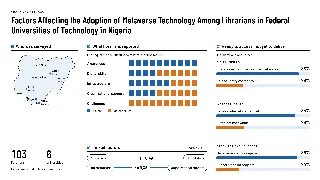
IntroductionLibrarians' readiness for metaverse technology in Nigerian universities of technology is not well documented. This study aimed to assess librarians' awareness, digital skills, perceived infrastructure, organizational support, and challenges regarding metaverse technology in Federal Universities of Technology in Nigeria, and to examine the relationships between awareness and digital skills and between infrastructure and organizational support.
MethodsThis cross-sectional survey was conducted between April and July 2026 in six Federal Universities of Technology in Nigeria. Academic librarians in these universities who agreed to participate were included, and incomplete questionnaires were excluded. Data were collected with a validated online questionnaire using four-point scales. Descriptive statistics were used with a criterion mean of 2.50, and Pearson correlation was used to test the hypotheses at a 0.05 significance level.
ResultsA total of 103 librarians were included. Overall, 97 (94.2%) reported very high or high awareness of the metaverse concept. While 91 (88.3%) reported being able to operate metaverse access devices, 29 (28.2%) reported being able to upload library content. Reliable internet connectivity was reported by 87 (84.5%), and augmented reality devices by 27 (26.2%). Inadequate training was the most highly rated challenge, reported by 98 (95.1%). Awareness was correlated with digital skills (r = 0.49, p < 0.001), and infrastructure with organizational support (r = 0.38, p < 0.001).
ConclusionLibrarians appeared to be aware of metaverse technology, but their skills and resources seemed better suited to accessing virtual environments than to delivering library services within them.
Keywords Metaverse technology Digital skills Technological infrastructure Organisational support Academic librarians All subjects
Barw Medical Journal. 2026;4(2):1–11
-
Parathyroid and Papillary Thyroid Carcinoma: A Case Series
Original Articles
Parathyroid and Papillary Thyroid Carcinoma: A Case Series
IntroductionParathyroid carcinoma (PC) is an exceptionally rare malignancy, whereas papillary thyroid carcinoma (PTC) is the most common thyroid cancer; their coexistence is extremely infrequent. This case series reports the synchronous occurrence of PC and PTC.
MethodsThis single-center case series included patients with synchronous PC and PTC diagnosed histopathologically according to the 2022 World Health Organization criteria between March 2021 and February 2026. Demographic, clinical, laboratory, radiological, management, and outcome data were retrieved from electronic records and analyzed descriptively.
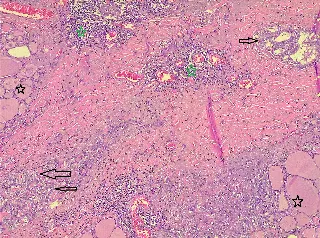
ResultsFour patients (three females, 75%) with a mean age of 60.25 years (range: 52–69 years) were included. Two patients (50%) underwent right thyroid lobectomy with right parathyroidectomy and lymph node dissection, one (25%) underwent total thyroidectomy with left parathyroidectomy, and one (25%) underwent total thyroidectomy, left parathyroidectomy, cervical lymph node dissection, and left superficial parotidectomy. One patient (25%) died after developing stridor due to bilateral vocal cord paralysis, whereas the other three were alive without local recurrence during follow-up (1–58 months).
ConclusionSynchronous PC and PTC can present incidentally or with nonspecific symptoms, and a coexisting thyroid malignancy may be overlooked when attention centers on the parathyroid tumor. Careful sonographic and histopathologic evaluation of both glands may improve detection in patients with thyroid or parathyroid lesions.
Keywords Endocrine malignancies Hyperparathyroidism Papillary thyroid carcinoma Parathyroid carcinoma Synchronous neoplasms All subjects
Barw Medical Journal. 2026;4(2):12–21
-