
Safety and Efficacy of Atezolizumab in Ovarian Cancer

Abstract
Introduction
Although the efficacy of PD-L1 blockade has been evaluated in analyses that combine pharmacologically distinct antibodies, the specific efficacy and safety of atezolizumab remain unclear. This review aimed to evaluate the efficacy and safety profile of atezolizumab specifically.
Methods
PubMed/MEDLINE and CENTRAL were searched (June 2026) for phase I to III trials of atezolizumab in ovarian cancer, reported in full-text English with at least 10 evaluable patients. Randomized and single-arm designs qualified. Randomized comparisons were pooled under random-effects models with Knapp-Hartung adjustment as hazard ratios for survival and risk ratios for response and safety; single-arm rates were pooled as proportions using generalized linear mixed models. Heterogeneity was assessed with I², Cochran Q, and prediction intervals, with leave-one-out sensitivity analysis. Analyses used R 4.6.0.
Results
Twelve studies (13 reports) enrolled 3,179 patients. Atezolizumab reduced the hazard of progression (HR 0.88, 95% CI 0.83 to 0.93) and death (HR 0.86, 95% CI 0.78 to 0.96), without heterogeneity (I² = 0%), whereas objective response was unchanged (RR 0.88, 95% CI 0.52 to 1.49). Excess toxicity was immune-mediated, raising serious adverse events (RR 1.32, 95% CI 1.05 to 1.67), any-grade immune-related events (RR 1.57, 95% CI 1.12 to 2.20), and grade ≥3 immune-related events (RR 2.23, 95% CI 1.05 to 4.74).
Conclusion
Atezolizumab adds a small survival benefit to a chemotherapy or bevacizumab backbone, driven by delayed progression rather than tumor regression. Offset by doubled immune toxicity and inseparable from its backbone, the effect may not justify routine use.
Introduction
Ovarian cancer (OC) is the most lethal gynecologic malignancy, marked by late-stage presentation and a high propensity for recurrence [1]. An estimated 313,959 new cases and 207,252 deaths occurred worldwide in 2020 [2], and 5-year survival for advanced disease remains near 17% [3]. Ovarian carcinoma comprises five histological subtypes, of which high-grade serous carcinoma predominates at 70%, followed by endometrioid and clear cell carcinoma at 10% each; most tumors are high-grade lesions that behave aggressively and present at an advanced stage [4].
Programmed cell death protein 1 (PD-1) is a key immune checkpoint receptor that regulates the immune response and maintains self-tolerance, and cancer cells co-opt this pathway to escape immune surveillance [5]. On activated T cells, PD-1 engages the ligands PD-L1 (programmed death-ligand 1) and PD-L2 (programmed death-ligand 2); tumors upregulate PD-L1 to suppress T-cell function and avoid destruction [6]. In OC, PD-L1 is expressed on tumor cells and tumor-infiltrating lymphocytes in more than half of patients, and higher CD8-positive lymphocyte density correlates with longer overall survival, providing a mechanistic rationale for blockade of this axis [3]. Atezolizumab, also designated MPDL3280A, is a monoclonal immunoglobulin G antibody that binds and inhibits PD-L1 [7]. Blockade of PD-L1 operates within a broader landscape of immunotherapeutic and molecularly targeted strategies, which includes T-cell-engaging agents and tyrosine kinase inhibitors [8,9].
Evidence for PD-1/PD-L1 blockade in OC derives largely from studies that combine antibodies with distinct molecular targets and pharmacologic profiles [10]. Atezolizumab enters such pooled estimates through only a limited number of studies [2], and its efficacy and safety in this setting remain poorly characterized relative to agents examined on their own [11]. This systematic review and meta-analysis study addresses that gap by focusing on the safety and efficacy of the addition of atezolizumab to standard therapy.
Methods
Study design
This systematic review and meta-analysis evaluated the safety and efficacy of atezolizumab in OC. The review was designed, conducted, and reported in accordance with the Preferred Reporting Items for Systematic Reviews and Meta-Analyses (PRISMA) 2020 statement.
Data sources and search strategy
PubMed/MEDLINE and the Cochrane Central Register of Controlled Trials (CENTRAL) were searched to identify studies evaluating atezolizumab in ovarian cancer. PubMed was searched on June 28, 2026, using the following string: ("Ovarian Neoplasms"[MeSH] OR "ovarian cancer"[tiab] OR "ovarian carcinoma"[tiab] OR "ovarian tumor"[tiab] OR "ovarian tumour"[tiab] OR "ovarian malignancy"[tiab] OR "epithelial ovarian"[tiab] OR "EOC"[tiab] OR "high-grade serous"[tiab] OR "HGSOC"[tiab] OR "primary peritoneal carcinoma"[tiab] OR "fallopian tube neoplasm"[tiab]) AND ("Atezolizumab"[MeSH] OR "atezolizumab"[tiab] OR "MPDL3280A"[tiab] OR "Tecentriq"[tiab] OR "anti-PD-L1"[tiab] OR "PD-L1 inhibitor"[tiab] OR "PD-L1 blockade"[tiab] OR "PD-L1 antibody"[tiab] OR "CD274"[tiab] OR "B7-H1"[tiab] OR "immune checkpoint inhibitor"[tiab] OR "Immune Checkpoint Inhibitors"[MeSH]). The CENTRAL search was conducted on June 29, 2026, restricted to title and abstract: (atezolizumab) AND ("ovarian cancer" OR ovary OR ovaries). No date, language, publication type, or other limits were applied to either search.
Eligibility criteria
Eligibility followed a pre-specified PICOS (Population, Intervention, Comparator, Outcomes, Study design) framework, with inclusion and exclusion criteria specified for each element.
Population. Eligible studies enrolled patients with OC of any histological subtype (epithelial, high-grade serous, clear cell, endometrioid, primary peritoneal, or fallopian tube carcinoma), with no restriction on age, performance status, BRCA (breast cancer susceptibility gene) status, or line of therapy. Studies were excluded when OC patients could not be separated from a mixed-tumor population, when fewer than 10 evaluable OC patients were reported, or when populations overlapped, in which case the most complete report was retained.
Intervention. The intervention was atezolizumab-based therapy at any dose or route, given as monotherapy or in combination with any other agent. Studies without an atezolizumab-containing arm extractable separately were excluded.
Comparator. Any comparator was eligible, whether placebo, standard of care, or an active agent, as were single-arm studies with no comparator.
Outcomes. Eligible studies reported at least one efficacy outcome (progression-free survival (PFS), overall survival (OS), or objective response rate (ORR)) or one safety outcome (adverse events (AE)s, serious AEs, treatment-related AEs, immune-related AEs (irAE)s, AE-related treatment discontinuation, or treatment-related deaths). Studies without extractable data for any pre-specified outcome were excluded.
Study design. Eligible designs were Phase II and III trials (randomized or single-arm) and Phase I/Ib trials reporting efficacy or safety data from an expansion cohort, limited to full-text original articles published in English with no date restriction. Preclinical studies, case reports, editorials, commentaries, narrative reviews, and conference abstracts were excluded, as were non-English or non–full-text publications and publications in non-recommended journals, in line with published guidance for identifying such venues [12].
Study selection process
Titles and abstracts were first screened in bulk for OC relevance, presence of an atezolizumab arm, clinical study design, and eligible publication type, with the remaining criteria applied at full-text review. Two researchers independently screened the titles and abstracts of all identified records against the predefined inclusion and exclusion criteria. Studies passing this stage underwent full-text assessment by the same reviewers. Disagreements over eligibility were resolved by a third researcher.
Data items and data extraction
For each eligible study, data were extracted per treatment arm, covering study identification, population characteristics, intervention and comparator, and efficacy and safety outcomes. Efficacy outcomes comprised PFS, OS, and objective response and its components, together with disease control rate; safety outcomes comprised any-grade and grade 3 or higher (grade ≥3) AEs, irAEs, treatment discontinuation, and treatment-related deaths. Proportions were recorded as raw event counts and denominators, and hazard ratios (HRs) with 95% confidence intervals (CIs) were taken only from randomized comparisons. The full list of extracted variables is provided in Table S1.
Data analysis and synthesis
Analyses were performed in R version 4.6.0 using the metafor and glmmTMB packages, and an outcome was pooled only when at least three studies contributed data. Comparative outcomes were drawn from randomized comparisons of atezolizumab added to a backbone regimen versus the same backbone with placebo, and all were pooled with the same random-effects model, using inverse-variance weighting with restricted maximum likelihood estimation of the between-study variance and the Knapp-Hartung adjustment to the confidence interval. Hazard ratios for PFS and OS were entered as log HRs with standard errors, whereas for objective response and the comparative safety outcomes (any-grade AEs, serious adverse events (SAEs), and irAEs, both any grade and grade ≥3) risk ratios (RRs) were computed from event counts, with a 0.5 continuity correction applied to studies with zero-event cells. Single-arm event frequencies in the atezolizumab arm were pooled as proportions for grade ≥3 AEs, treatment-related grade ≥3 AEs, SAEs, adverse-event-related treatment discontinuation, and grade 5 or treatment-related deaths, using a binomial generalized linear mixed model with multiple arms within a study modeled hierarchically where applicable. Heterogeneity was assessed with the I-squared statistic, tau-squared, the Cochran Q test, and prediction intervals, and leave-one-out omission was used as a sensitivity analysis across pooled outcomes if the number of contributing studies was more than 3.
Methodological quality assessment
Randomized trials were assessed with the Cochrane Risk of Bias 2 (RoB 2) tool across its five domains, with an overall judgment of low risk, some concerns, or high risk. Data sets analyzed as single arms, comprising the single-arm trials and the randomized trials that contributed single-arm data only, were assessed with the non-comparative Methodological Index for Non-Randomized Studies (MINORS), scoring eight items from 0 to 2 for a maximum of 16.
Certainty of evidence was rated with the Grading of Recommendations Assessment, Development, and Evaluation (GRADE) framework for each of the fourteen outcomes. The nine comparative outcomes (PFS, PFS [PD-L1-Positive], OS, OS [PD-L1-Positive], ORR, and the any-grade, SAEs, and irAE risk ratios) were graded as effect estimates versus control and, being derived from randomized trials, began at high certainty; the five single-arm outcomes were graded as certainty in a pooled proportion and began at low certainty. Ratings considered risk of bias, inconsistency, indirectness, imprecision, and other considerations, with the risk-of-bias domain drawn from the RoB 2 and MINORS assessments. Evidence was classified as high, moderate, low, or very low certainty.
Results
Study selection
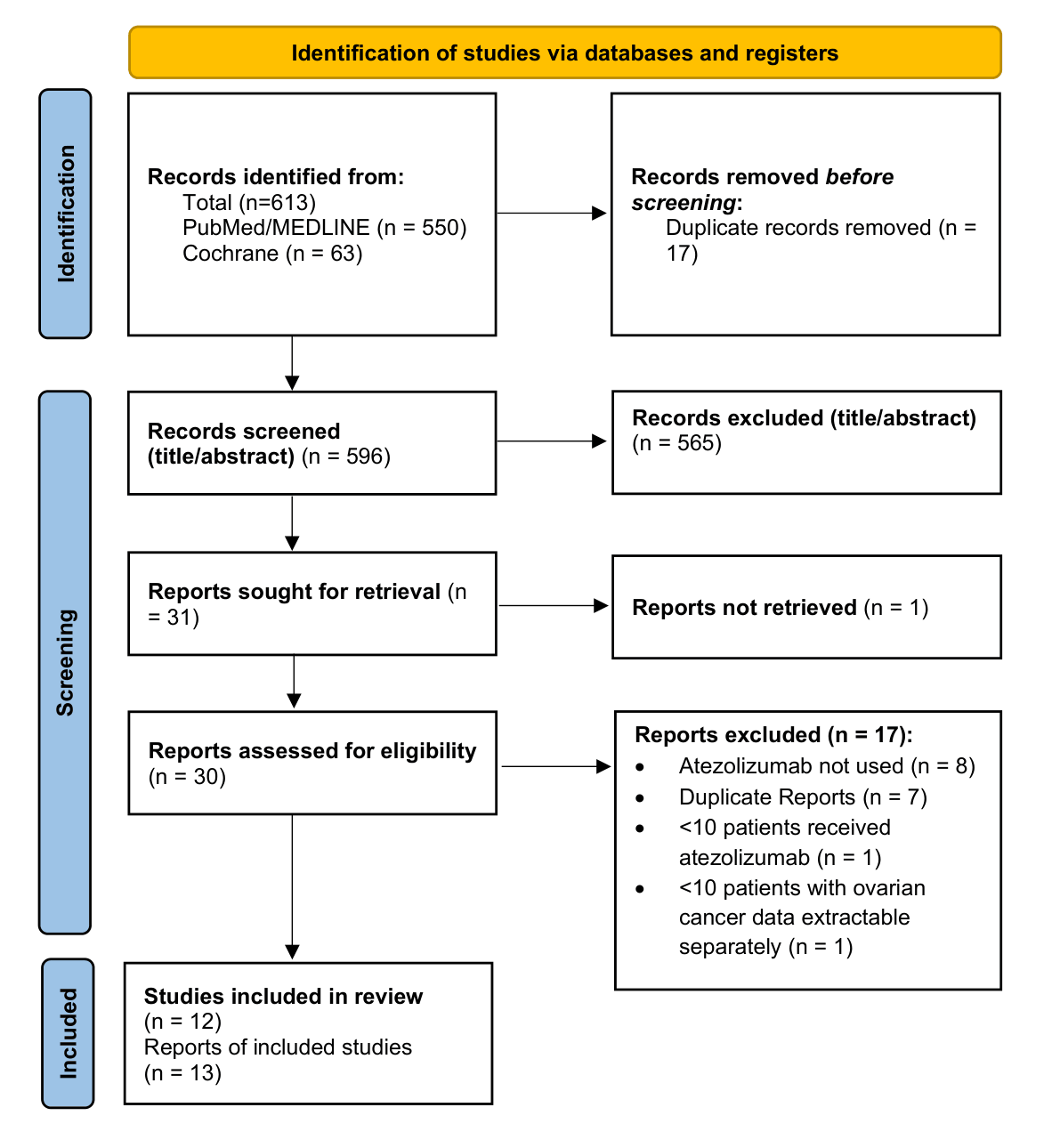
A total of 613 records were identified, comprising 550 from PubMed/MEDLINE and 63 from CENTRAL (Cochrane Central Register of Controlled Trials). After removal of 17 duplicates, 596 records underwent title and abstract screening, of which 565 were excluded. Thirty-one reports were sought for retrieval; one could not be obtained, leaving 30 for full-text assessment. Of these, 17 were excluded: eight lacked an atezolizumab arm, seven were duplicate reports of an already-included study, one had fewer than 10 patients in the atezolizumab arm, and one had fewer than 10 evaluable OC patients separable from a mixed population. Twelve studies, described in 13 reports, met all eligibility criteria and entered the review [13–25] (Figure 1).
Study and patient characteristics
The 12 included studies enrolled 3,179 patients and were published between 2019 and 2026. By design, 4 (33.3%) were randomized, double-blind, placebo-controlled, 3 (25.0%) randomized, open-label, and 5 (41.7%) single-arm. Four studies (33.3%) were phase III and accounted for 2,906 patients; the remaining eight (66.7%) were phase I to II, comprising 1 (8.3%) phase II, 6 (50.0%) phase Ib or I, and 1 (8.3%) phase I/II. Seven studies were randomized, and five were single-arm (Table 1 & Table 2).
|
Study Information |
Population |
Time-to-event |
Response |
||||||||||||||||||||||||||
|
Study (author, year) |
Trial / acronym |
Population/line |
Study Arm(s) |
Phase |
Design |
Analysis pool |
NCT no. |
N enrolled (ITT) |
N treated (safety) |
N evaluable (response) |
Median PFS (mo) |
PFS events n |
PFS HR (95% CI) |
PFS population |
Median OS (mo) |
OS events n |
OS HR (95% CI) |
1-yr PFS % |
1-yr OS % |
ORR n |
ORR N |
CR n |
PR n |
SD n |
PD n |
DCR n |
DCR N |
DCR definition |
Response criteria |
|
Banerjee et al. 2025 [13] |
EORTC 1508-GCG |
Recurrent, platinum-resistant |
Arm 4: Bev + atezo + placebo |
II |
Randomized, open-label |
Both (proportion + HR vs Arm 1) |
NCT02659384 |
32 |
31 |
32 |
4.1 |
28 |
0.84 (0.50–1.38) |
ITT (vs Arm 1) |
12.1 |
22 |
0.89 (0.49–1.59) |
NR |
NR |
6 |
32 |
1 |
5 |
NR |
22 |
21 |
32 |
NR |
RECIST 1.1 |
|
Arm 1: Bev monotherapy (COMPARATOR) |
II |
Randomized, open-label |
HR comparator |
NCT02659384 |
33 |
31 |
33 |
2.3 |
32 |
NR |
ITT (reference) |
10.4 |
23 |
NR |
NR |
NR |
3 |
33 |
0 |
3 |
NR |
27 |
21 |
33 |
NR |
RECIST 1.1 |
|||
|
Arm 5: Bev + atezo + ASA |
II |
Randomized, open-label |
Proportion (HR shares Arm 1 control; excl. from HR pool) |
NCT02659384 |
33 |
33 |
33 |
4 |
29 |
0.81 (0.49–1.34) |
ITT (vs Arm 1) |
11.6 |
22 |
0.71 (0.39–1.28) |
NR |
NR |
6 |
33 |
1 |
5 |
NR |
26 |
22 |
33 |
NR |
RECIST 1.1 |
|||
|
Gaillard et al. 2026 [14] |
AdORN |
First-line, neoadjuvant + interval surgery |
Atezolizumab + NACT (wkly pac/carbo) -> maint atezo +/- bev |
Ib |
Single-arm / non-randomized |
Proportion |
NCT03394885 |
18 |
18 |
15 |
23.6 |
8 |
NR |
ITT |
NR |
NR |
NR |
NR |
NR |
9 |
15 |
0 |
9 |
6 |
0 |
15 |
15 |
Sum of partial response and stable disease. |
RECIST 1.1 |
|
Gonzalez-Martin et al. 2025 [15] |
ANITA / ENGOT-OV41 / GEICO 69-O |
Recurrent (platinum-based) + maintenance niraparib |
Atezolizumab + platinum CT → Atezolizumab + Niraparib |
III |
Randomized, double-blind, placebo-controlled |
Both (HR + proportion) |
NCT03598270 |
208 |
207 |
208 |
11.2 |
170 |
0.89 (0.71–1.10) |
ITT |
NR |
NR |
NR |
44 |
NR |
93 |
207 |
14 |
79 |
91 |
NR |
NR |
NR |
NR |
RECIST 1.1 |
|
Placebo + platinum CT → Placebo + Niraparib |
III |
Randomized, double-blind, placebo-controlled |
HR comparator |
NCT03598270 |
209 |
209 |
209 |
10.1 |
174 |
NR |
ITT |
NR |
NR |
NR |
35 |
NR |
90 |
209 |
13 |
79 |
96 |
NR |
NR |
NR |
NR |
RECIST 1.1 |
|||
|
Harter et al. 2026 [16] |
AGO-OVAR 2.29 / ENGOT-ov34 |
Recurrent, non-platinum CT |
Atezolizumab + bev + non-plat CT |
III |
Randomized, double-blind, placebo-controlled |
Both (HR + proportion) |
NCT03353831 |
285 |
281 |
255 |
6.4 |
243 |
0.87 (0.73–1.04) |
ITT |
14.2 |
197 |
0.83 (0.68–1.01) |
28 |
58 |
101 |
255 |
11 |
90 |
91 |
NR |
NR |
NR |
NR |
NR |
|
Placebo + bev + non-plat CT |
III |
Randomized, double-blind, placebo-controlled |
HR comparator |
NCT03353831 |
289 |
286 |
248 |
6.7 |
261 |
NR |
ITT |
13 |
221 |
NR |
23 |
56 |
108 |
248 |
6 |
102 |
87 |
NR |
NR |
NR |
NR |
NR |
|||
|
Kristeleit et al. 2024 [17] |
COUPLET |
Platinum-sensitive recurrent, tBRCAmut |
Part 2 Arm A: rucaparib + atezo, tBRCAmut ovarian |
Ib |
Single-arm / non-randomized |
Proportion |
NCT03101280 |
10 |
10 |
10 |
NR |
NR |
NR |
ITT |
NR |
NR |
NR |
NR |
NR |
6 |
10 |
1 |
5 |
NR |
NR |
NR |
10 |
NR |
RECIST 1.1 |
|
Kurtz et al. 2023 [18] |
ATALANTE / ENGOT-ov29 |
Platinum-sensitive recurrent |
Atezolizumab + bev + platinum CT |
III |
Randomized, double-blind, placebo-controlled |
Both (HR + proportion) |
NCT02891824 |
410 |
408 |
410 |
13.5 |
348 |
0.83 (0.69–0.99) |
ITT |
35.5 |
NR |
0.81 (0.65–1.01) |
56 |
89 |
62 |
410 |
NR |
NR |
NR |
NR |
NR |
NR |
NR |
RECIST 1.1 |
|
Placebo + bev + platinum CT |
III |
Randomized, double-blind, placebo-controlled |
HR comparator |
NCT02891824 |
204 |
201 |
204 |
11.3 |
187 |
NR |
ITT |
30.6 |
NR |
NR |
46 |
87 |
66 |
204 |
NR |
NR |
NR |
NR |
NR |
NR |
NR |
RECIST 1.1 |
|||
|
Liu et al. 2019 [19] |
PCD4989g |
Advanced, monotherapy |
Atezolizumab monotherapy (ovarian cohort) |
Ia/I |
Single-arm / non-randomized |
Proportion |
NCT01375842 |
12 |
12 |
9 |
2.9 |
NR |
NR |
Efficacy evaluable (n=10) |
11.3 |
NR |
NR |
20 |
41.7 |
2 |
9 |
1 |
1 |
0 |
5 |
2 |
9 |
Percentage of patients with best response of CR, PR or SD for ≥24 weeks |
RECIST 1.1 |
|
Moore et al. 2021 & Pignata et al. 2023 [20, 21]
|
IMagyn050 / GOG-3015 / ENGOT-OV39
|
First-line, newly diagnosed stage III/IV
|
Atezolizumab + carboplatin/paclitaxel + bevacizumab |
III |
Randomized, double-blind, placebo-controlled |
Both (HR + proportion) |
NCT03038100 |
651 |
642 |
251 |
19.5 |
323 |
0.92 (0.79–1.07) |
ITT |
50.5 |
254 |
0.92 (0.78–1.09) |
NR |
NR |
233 |
251 |
NR |
NR |
NR |
NR |
NR |
NR |
NR |
RECIST 1.1 |
|
Placebo + carboplatin/paclitaxel + bevacizumab |
III |
Randomized, double-blind, placebo-controlled |
HR comparator |
NCT03038100 |
650 |
644 |
239 |
18.4 |
341 |
NR |
ITT |
46.6 |
278 |
NR |
NR |
NR |
212 |
239 |
NR |
NR |
NR |
NR |
NR |
NR |
NR |
RECIST 1.1 |
|||
|
Moroney et al. 2020 [22] |
GP28328 |
Recurrent ovarian |
Atezolizumab + bevacizumab |
Ib |
Single-arm / non-randomized |
Proportion |
NCT01633970 |
20 |
20 |
20 |
4.9 |
NR |
NR |
Safety evaluable |
10.2 |
NR |
NR |
NR |
48.75 |
3 |
20 |
0 |
3 |
8 |
5 |
11 |
20 |
≥12 weeks |
RECIST 1.1 |
|
Mutch et al. 2024 [23] |
YO40482 |
Platinum-sensitive recurrent, BRCA-wt |
Triplet: PARPi + MEKi + atezolizumab |
Ib |
Randomized, open-label |
Both (HR + proportion) |
NCT03695380 |
37 |
37 |
37 |
7.4 |
28 |
NR |
ITT |
NR |
NR |
NR |
NR |
73 |
NR |
37 |
NR |
NR |
NR |
NR |
NR |
NR |
NR |
RECIST 1.1 |
|
Doublet: PARPi + MEKi (no atezo) |
Ib |
Randomized, open-label |
HR comparator |
NCT03695380 |
39 |
39 |
39 |
6 |
28 |
NR |
ITT |
NR |
NR |
NR |
NR |
82 |
NR |
39 |
NR |
NR |
NR |
NR |
NR |
NR |
NR |
RECIST 1.1 |
|||
|
Rocconi et al. 2022 [24] |
— |
Relapsed ovarian |
Atezo-1st |
I |
Randomized, open-label |
Proportion |
NCT03073526 |
10 |
10 |
10 |
2.8 |
NR |
NR |
ITT |
10.8 |
NR |
NR |
NR |
NR |
NR |
10 |
NR |
NR |
NR |
NR |
NR |
NR |
NR |
RECIST 1.1 |
|
Vigil-1st |
I |
Randomized, open-label |
Proportion |
NCT03073526 |
11 |
11 |
11 |
3.4 |
NR |
0.76 (0.28–2.00) |
ITT |
NR |
NR |
0.33 (0.06–1.70) |
NR |
NR |
NR |
11 |
NR |
NR |
NR |
NR |
NR |
NR |
NR |
RECIST 1.1 |
|||
|
Simonelli et al. 2022 [25] |
ACT15377 |
Advanced solid tumors (ovarian cohort) |
Isatuximab + atezolizumab (OVARIAN subset only) |
I/II |
Single-arm / non-randomized |
Proportion |
NCT03637764 |
18 |
18 |
18 |
2.04 |
NR |
NR |
all treated |
NR |
NR |
NR |
NR |
NR |
1 |
18 |
0 |
1 |
6 |
10 |
7 |
18 |
Not Defined |
RECIST 1.1 |
|
Abbreviations: AGO-OVAR, Arbeitsgemeinschaft Gynäkologische Onkologie–Ovarian Cancer Study Group; ASA, acetylsalicylic acid (aspirin); atezo, atezolizumab; bev, bevacizumab; BRCA-wt, BRCA wild-type; carbo, carboplatin; CI, confidence interval; CR, complete response; CT, chemotherapy; DCR, disease control rate; ENGOT, European Network of Gynaecological Oncological Trial groups; EORTC, European Organisation for Research and Treatment of Cancer; GCG, Gynaecological Cancer Group; GEICO, Grupo Español de Investigación en Cáncer de Ovario; GOG, Gynecologic Oncology Group; HR, hazard ratio; ITT, intention-to-treat; maint, maintenance; MEKi, MEK inhibitor; mo, months; NACT, neoadjuvant chemotherapy; NCT, ClinicalTrials.gov registration number; NR, not reported; ORR, objective response rate; OS, overall survival; pac, paclitaxel; PARPi, poly(ADP-ribose) polymerase inhibitor; PD, progressive disease; PFS, progression-free survival; PR, partial response; RECIST, Response Evaluation Criteria in Solid Tumors; SD, stable disease; tBRCAmut, tumor BRCA-mutated; wkly, weekly. |
|||||||||||||||||||||||||||||
|
Characteristic |
n (%) |
|
Study & Trial Characteristics |
|
|
Study Design (N=12) |
|
|
Randomized, double-blind, placebo-controlled |
4 (33.3%) |
|
Randomized, open-label |
3 (25.0%) |
|
Single-arm / non-randomized |
5 (41.7%) |
|
Trial Phase (N=12) |
|
|
Phase III |
4 (33.3%) |
|
Phase II |
1 (8.3%) |
|
Phase Ib |
4 (33.3%) |
|
Phase I |
1 (8.3%) |
|
Phase Ia/I |
1 (8.3%) |
|
Phase I/II |
1 (8.3%) |
|
Patient Baseline Characteristics |
|
|
Histology (N=3118) |
|
|
High-grade serous |
2335 (74.9%) |
|
Low-grade serous |
183 (5.9%) |
|
Serous (grade unspecified) |
180 (5.8%) |
|
Endometrioid |
99 (3.2%) |
|
Clear cell |
109 (3.5%) |
|
Seromucinous |
32 (1.0%) |
|
Mucinous |
17 (0.5%) |
|
Other |
163 (5.2%) |
|
FIGO Tumor Stage (N=1437) |
|
|
Stage I |
2 (0.1%) |
|
Stage II |
4 (0.3%) |
|
Stage III |
988 (68.8%) |
|
Stage IV |
442 (30.8%) |
|
Unknown / Missing |
1 (0.1%) |
|
ECOG Performance Status (N=3169) |
|
|
0 |
1848 (58.3%) |
|
1 |
1240 (39.1%) |
|
2 |
71 (2.2%) |
|
Missing |
10 (0.3%) |
|
PD-L1 Status (N=2938) |
|
|
PD-L1 Positive |
1314(44.7%) |
|
PD-L1 Negative |
1362 (46.4%) |
|
Other (noninformative / missing / unknown) |
262 (8.9%) |
|
Prior Therapy Lines (N=3168) |
|
|
No prior therapy (treatment-naive) |
1320 (41.7%) |
|
1 prior line/regimen |
1033 (32.6%) |
|
2 prior lines/regimens |
455 (14.4%) |
|
3 prior lines/regimens |
213 (6.7%) |
|
Missing |
3 (0.1%) |
|
Other (≥3 / range-reported) |
144 (4.5%) |
|
Efficacy and Safety Outcomes |
|
|
Response |
|
|
ORR (objective response) (N=2193) |
1001 (45.7%) |
|
Complete response (CR) (N=1089) |
48 (4.4%) |
|
Partial response (PR) (N=1089) |
382 (35.1%) |
|
Stable disease (SD) (N=981) |
385 (39.3%) |
|
Progressive disease (PD) (N=160) |
95 (59.4%) |
|
DCR (disease control) (N=160) |
99 (61.9%) |
|
Worst AE Grade (N=2296) |
|
|
Grade 1–2 (mild–moderate) |
562 (24.5%) |
|
Grade 3–4 (severe, non-fatal) |
1700 (74.0%) |
|
Grade 5 (fatal) |
22 (1.0%) |
|
Not separable (any-grade only) |
12 (0.5%) |
|
Abbreviations: AE, adverse event; CR, complete response; DCR, disease control rate; ECOG, Eastern Cooperative Oncology Group; FIGO, International Federation of Gynecology and Obstetrics; ORR, objective response rate; PD, progressive disease; PD-L1, programmed death ligand 1; PR, partial response; SD, stable disease. |
|
Enrollment was largely restricted to good functional status. Pooled across studies, 1,848 (58.3%) patients had an Eastern Cooperative Oncology Group (ECOG) performance status of 0, 1,240 (39.1%) a status of 1, and 71 (2.2%) a status of 2. Prior treatment exposure spanned the full disease course: 1,320 patients (41.7%) were treatment-naive, 1,033 (32.6%) had received one prior line, 455 (14.4%) two lines, and 213 (6.7%) three lines. High-grade serous carcinoma predominated, at 2,335 (74.9%) patients of those with reported histology. Among patients with staging data, disease was predominantly advanced, 988 (68.8%) stage III and 442 (30.8%) stage IV. Expression of PD-L1 was positive in 1,314 (44.7%) and negative in 1,362 (46.4%), with 262 (8.9%) noninformative or unknown (Table 2 & Table 3).
|
Study & arm characteristics |
Histology, n (%) |
Tumor Stage, n (%) |
Performance status, n (%) |
Prior therapy lines, n (%) |
|||||||||||||||||||
|
Study (year) / trial |
Arm |
N |
High-grade serous |
Low-grade serous |
Serous, NOS |
Endometrioid |
Clear cell |
Other / mixed |
Stage 1 |
Stage 2 |
Stage 3 |
Stage 4 |
Unknown |
PS 0 |
PS 1 |
PS 2 |
Missing / other |
Treatment-naïve |
1 line |
2 lines |
≥3 lines |
Grouped (as reported) |
Missing |
|
Banerjee et al. 2025 [13] |
Bev monotherapy (Arm 1) |
33 |
— |
— |
25 (75.8) |
0 (0) |
3 (9.1) |
5 (15.2)* |
1 (3.0%) |
1 (3.0%) |
22 (66.7%) |
9 (27.3%) |
0 |
14 (42.4) |
19 (57.6) |
0 (0) |
— |
— |
— |
— |
28 (84.8) |
≤2: 5 (15.2) |
— |
|
Bev + atezo + placebo (Arm 4) |
32 |
— |
— |
28 (87.5) |
1 (3.1) |
2 (6.3) |
1 (3.1) |
1 (3.1%) |
2 (6.3%) |
21 (65.6%) |
7 (21.9%) |
1 (3.1%) |
13 (40.6) |
19 (59.4) |
0 (0) |
— |
— |
— |
— |
27 (84.4) |
≤2: 5 (15.6) |
— |
|
|
Bev + atezo + ASA (Arm 5) |
33 |
— |
— |
33 (100) |
0 (0) |
0 (0) |
0 (0) |
0 (0.0%) |
1 (3.0%) |
19 (57.6%) |
13 (39.4%) |
0 |
23 (69.7) |
10 (30.3) |
0 (0) |
— |
— |
— |
— |
27 (81.8) |
≤2: 6 (18.2) |
— |
|
|
Gaillard et al. 2026 [14] |
Atezo + neoadjuvant CT → maint. atezo ± bev |
18 |
18 (100) |
— |
— |
— |
— |
— |
0 |
0 |
13 (72.2%) |
5 (27.8%) |
0 |
2 (11.1) |
11 (61.1) |
5 (27.8) |
— |
18 (100) |
— |
— |
— |
— |
— |
|
González-Martín et al. 2025 [15] |
Atezo → atezo + niraparib |
208 |
187 (90) |
— |
— |
11 (5) |
— |
10 (4.8)* |
NR |
NR |
NR |
NR |
NR |
132 (63) |
73 (35) |
— |
Missing 3 (1) |
— |
181 (87) |
26 (13) |
— |
— |
1 (<1) |
|
Placebo → placebo + niraparib |
209 |
196 (94) |
— |
— |
5 (2) |
— |
8 (3.8)* |
NR |
NR |
NR |
NR |
NR |
123 (59) |
82 (39) |
— |
Missing 4 (2) |
— |
179 (86) |
28 (13) |
— |
— |
2 (1) |
|
|
Harter et al. 2026 [16] |
Atezo + bev + non-platinum CT |
285 |
214 (75) |
8 (2.8) |
— |
12 (4.2) |
17 (6.0) |
34 (11.9)* |
NR |
NR |
NR |
NR |
NR |
163 (57) |
120 (42) |
— |
Missing 2 (0.7) |
— |
70 (25) |
112 (39) |
103 (36) |
— |
— |
|
Placebo + bev + non-platinum CT |
289 |
230 (80) |
10 (3.5) |
— |
8 (2.8) |
16 (5.5) |
25 (8.7)* |
NR |
NR |
NR |
NR |
NR |
152 (53) |
136 (47) |
— |
Missing 1 (0.3) |
— |
70 (24) |
115 (40) |
104 (36) |
— |
— |
|
|
Kristeleit et al. 2024 [17] |
Rucaparib + atezo (Arm A)‡ |
10 |
NR |
NR |
NR |
NR |
NR |
NR |
NR |
NR |
NR |
NR |
NR |
NR |
NR |
NR |
NR |
NR |
NR |
NR |
NR |
NR |
NR |
|
Kurtz et al. 2023 [18] |
Atezo + bev + platinum CT |
410 |
346 (84) |
32 (8) |
— |
12 (3) |
8 (2) |
12 (3) |
NR |
NR |
NR |
NR |
NR |
277 (68) |
131 (32) |
2 (<1) |
— |
— |
307 (75) |
103 (25) |
— |
— |
— |
|
Placebo + bev + platinum CT |
204 |
169 (83) |
8 (4) |
— |
11 (5) |
9 (4) |
7 (3) |
NR |
NR |
NR |
NR |
NR |
147 (72) |
57 (28) |
0 (0) |
— |
— |
159 (78) |
45 (22) |
— |
— |
— |
|
|
Liu et al. 2019 [19] |
Atezo monotherapy |
12 |
NR |
NR |
NR |
NR |
NR |
NR |
NR |
NR |
NR |
NR |
NR |
6 (50.0) |
6 (50.0) |
— |
— |
1 (8.3)‖ |
0 (0) |
— |
— |
≥2: 11 (91.7) |
— |
|
Moore et al. 2021 [20,21] |
Atezo + carbo/pac + bev |
651 |
504 (77) |
67 (10) |
— |
14 (2) |
29 (4) |
37 (6) |
0 |
0 |
448 (69%) |
203 (31%) |
0 |
355 (55) |
263 (40)* |
33 (5)* |
— |
651 (100) |
— |
— |
— |
— |
— |
|
Placebo + carbo/pac + bev |
650 |
489 (75) |
58 (9) |
— |
21 (3) |
22 (3) |
60 (9) |
0 |
0 |
448 (69%) |
201 (31%) |
0 |
353 (54) |
266 (41)* |
31 (5)* |
— |
650 (100) |
— |
— |
— |
— |
— |
|
|
Moroney et al. 2020 [22] |
Atezo + bev |
20 |
— |
— |
12 (60) |
3 (15) |
2 (10) |
3 (15) |
NR |
NR |
NR |
NR |
NR |
11 (55) |
9 (45) |
— |
— |
— |
— |
— |
13 (65)* |
1–2: 7 (35)§ |
— |
|
Mutch et al. 2024 [23] |
Cobi + nira + atezo (triplet) |
37 |
— |
— |
31 (84) |
— |
— |
6 (16) |
NR |
NR |
NR |
NR |
NR |
25 (78)† |
12 (22)† |
— |
— |
— |
29 (68) |
8 (32) |
— |
— |
— |
|
Cobi + nira (doublet) |
39 |
— |
— |
35 (90) |
— |
— |
4 (10) |
NR |
NR |
NR |
NR |
NR |
31 (79) |
8 (21) |
— |
— |
— |
27 (69) |
11 (28) |
— |
— |
1 (3) |
|
|
Rocconi et al. 2022 [24] |
Atezo first (then Vigil) |
10 |
NR |
NR |
NR |
NR |
NR |
NR |
0 |
0 |
9 (90.0%) |
1 (10.0%) |
0 |
2 (20.0) |
8 (80.0) |
— |
— |
— |
2 (20)§ |
3 (30) |
5 (50)* |
— |
— |
|
Vigil first (then atezo) |
11 |
NR |
NR |
NR |
NR |
NR |
NR |
0 |
0 |
8 (72.7%) |
3 (27.3%) |
0 |
7 (63.6) |
4 (36.4) |
— |
— |
— |
5 (45.5)§ |
4 (36.4) |
2 (18.2)* |
— |
— |
|
|
Simonelli et al. 2022 [25] |
Isatuximab + atezo |
18 |
— |
— |
16 (88.9) |
1 (5.6) |
1 (5.6) |
— |
NR |
NR |
NR |
NR |
NR |
12 (66.7) |
6 (33.3) |
— |
— |
— |
4 (22.2) |
— |
— |
≥2: 14 (77.8)§ |
— |
|
Abbreviations: ASA, acetylsalicylic acid; atezo, atezolizumab; bev, bevacizumab; carbo, carboplatin; cobi, cobimetinib; CT, chemotherapy; maint., maintenance; nira, niraparib; NOS, not otherwise specified; NR, not reported; pac, paclitaxel; PS, performance status. Notes affecting how a value reads. * Percentage recomputed from N (not printed by the trial); all other percentages are as reported. † Mutch triplet: printed performance-status percentages (78 / 22) do not reconcile with n = 37 (25/37 ≈ 68 %, 12/37 ≈ 32 %); shown as printed. ‡ Kristeleit: Arm A not reported separately; values are pooled Part 2 ovarian Arms A + B (n = 14) — e.g., PS 0 = 11 (79), PS 1 = 3 (21); eligibility was 1–2 prior platinum-containing regimens.
‖ Liu: “treatment-naïve” = 0 prior lines (advanced-disease phase Ia setting). ¶ Moore (IMagyn050) baseline is shared with Pignata 2023 (OS/PRO update of the same randomized population) and is listed once. |
|||||||||||||||||||||||
Efficacy
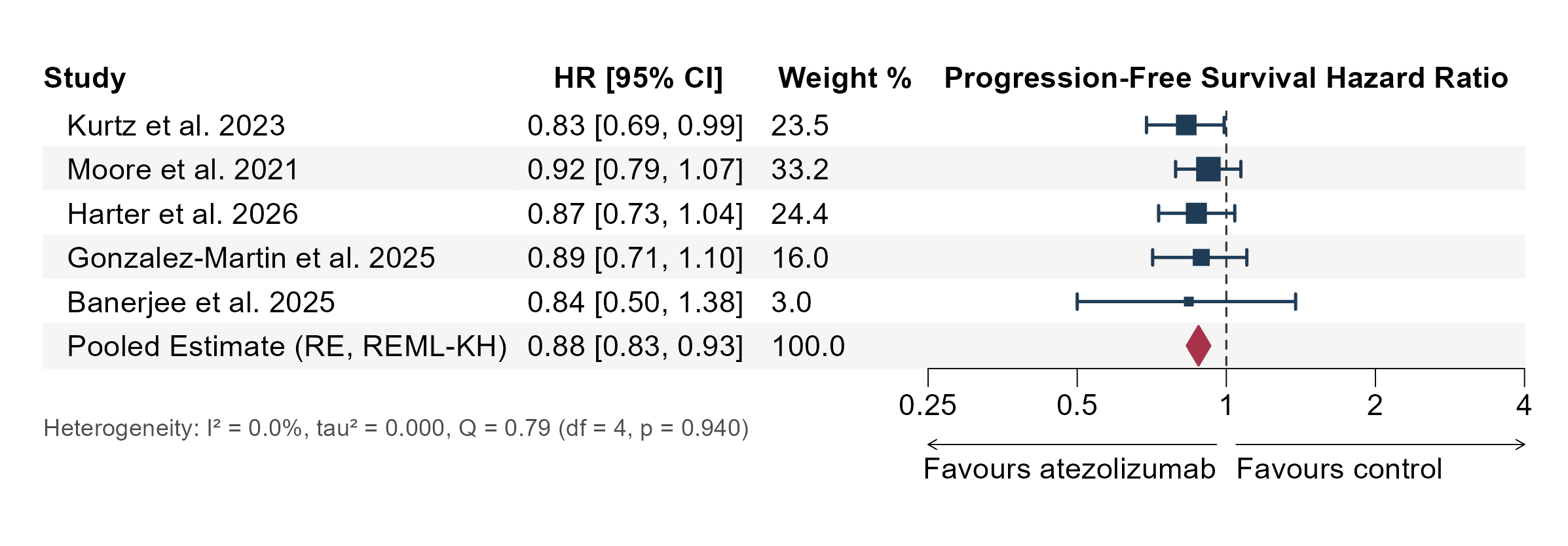
Progression-free survival was pooled from five randomized comparisons of atezolizumab added to a backbone regimen versus the backbone with placebo. The pooled HR was 0.88 (95% CI 0.83 to 0.93, p = 0.003), favoring atezolizumab, with no detectable heterogeneity (I² = 0.0%, Q p = 0.94) and a stable estimate across leave-one-out analysis (HR 0.86 to 0.89). In the PD-L1–positive subgroup, progression-free survival was pooled from four randomized comparisons (1297 patients; 686 atezolizumab, 611 control), giving a pooled HR of 0.82 (95% CI 0.76 to 0.89, p = 0.004), likewise favoring atezolizumab, again without heterogeneity (I² = 0.0%, Q p = 0.95) and stable on leave-one-out analysis (HR 0.81 to 0.84) (Figure 2).
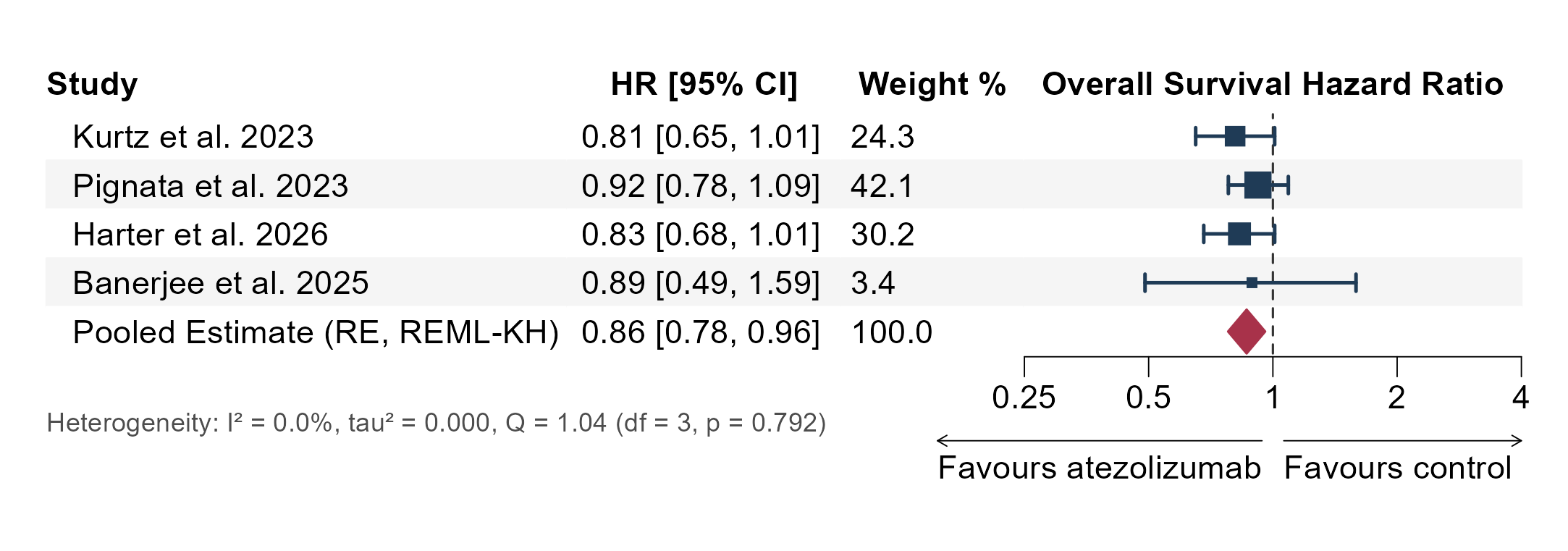
Overall survival, pooled from four randomized comparisons, gave an HR of 0.86 (95% CI 0.78 to 0.96, p = 0.021), again favoring atezolizumab, without heterogeneity (I² = 0.0%, Q p = 0.79) and consistent on leave-one-out analysis (HR 0.82 to 0.88). In the PD-L1–positive subgroup, overall survival was pooled from three randomized comparisons (1148 patients; 610 atezolizumab, 538 control), giving an HR of 0.83 (95% CI 0.71 to 0.98, p = 0.040), also favoring atezolizumab and without heterogeneity (I² = 0.0%, Q p = 0.85). Leave-one-out analysis was not performed for this outcome, as omitting any single trial would have left fewer than three studies (Figure 3).
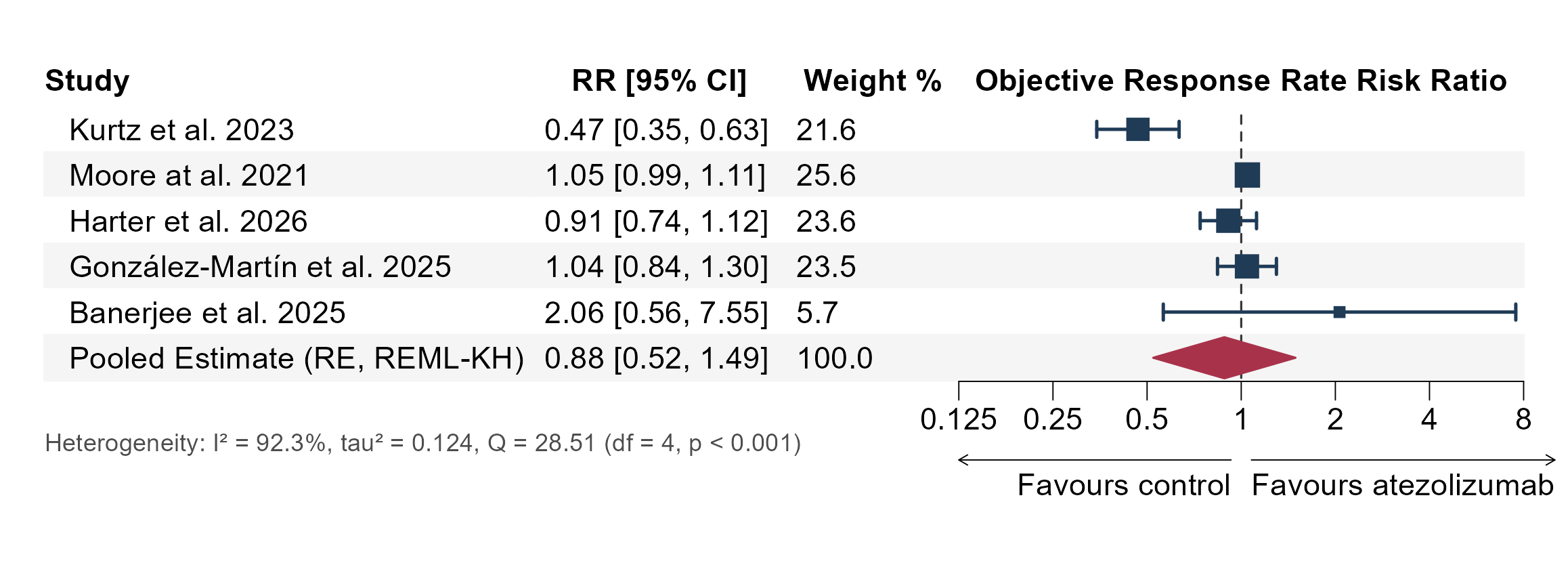
Objective response, pooled from five randomized comparisons, gave an RR of 0.88 (95% CI 0.52 to 1.49, p = 0.55), showing no significant difference between atezolizumab and control. Unlike the survival endpoints, heterogeneity was substantial (I² = 92.3%, Q p < 0.001), with per-study risk ratios spanning both directions (0.47 to 2.06) and a wide prediction interval (0.25 to 3.15); the pooled estimate ranged from 0.84 to 1.04 on leave-one-out analysis (Figure 4).
Safety
Adverse event profile
The overall AE profile was dominated by events attributable to the chemotherapy and anti-angiogenic backbone, which occurred at similar frequencies in both arms. Common all-grade events included fatigue (42% with atezolizumab vs 41% with control), nausea (52% vs 55%), anemia (43% vs 42%), neutropenia (35% vs 35%), and alopecia (47% vs 51%). Grade ≥3 AEs were predominantly hematologic and comparable between arms, including neutropenia (23% vs 23%), anemia (13% vs 11%), thrombocytopenia (12% vs 12%), and hypertension (14% vs 14%).
The excess toxicity associated with atezolizumab was concentrated in immune-related, cutaneous, and endocrine categories. Relative to control arms, atezolizumab-containing arms showed higher rates of rash (23% vs 15%), maculopapular rash (9% vs 3%), pruritus (14% vs 9%), pyrexia (20% vs 10%), hypothyroidism (12% vs 5%), and colitis (3% vs 1%), together with a higher rate of composite immune mediated events (27% vs 21%), including at grade ≥3 AEs (11% vs 6%) (Table 4).
|
Adverse event
|
Atezolizumab arms |
Non-atezolizumab arms |
||
|
All grade |
Grade ≥3 |
All grade |
Grade ≥3 |
|
|
General / constitutional |
||||
|
Fatigue |
531/1261 (42%) |
40/1261 (3%)* |
495/1209 (41%) |
31/1209 (3%)* |
|
Asthenia |
222/898 (25%) |
22/898 (2%)* |
217/892 (24%) |
19/892 (2%)* |
|
Pyrexia / fever |
188/925 (20%) |
7/945 (1%)* |
85/884 (10%) |
8/884 (1%)* |
|
Decreased appetite / anorexia |
132/962 (14%) |
34/962 (4%)* |
120/923 (13%) |
34/923 (4%)* |
|
Weight loss |
22/82 (27%) |
0/82 (0%)* |
5/31 (16%) |
0/31 (0%) |
|
Mucositis / mucosal inflammation |
55/308 (18%) |
3/308 (1%)* |
54/279 (19%) |
3/279 (1%)* |
|
Peripheral edema |
9/64 (14%) |
0/64 (0%) |
2/31 (6%) |
0/31 (0%) |
|
Gastrointestinal |
||||
|
Nausea |
505/980 (52%) |
24/1000 (2%)* |
510/923 (55%) |
8/923 (1%)* |
|
Vomiting |
252/980 (26%) |
29/1000 (3%)* |
254/923 (28%) |
13/923 (1%)* |
|
Diarrhea |
441/1249 (35%) |
38/1249 (3%)* |
379/1209 (31%) |
32/1209 (3%)* |
|
Constipation |
361/950 (38%) |
5/950 (1%)* |
362/923 (39%) |
9/923 (1%)* |
|
Abdominal pain |
378/1261 (30%) |
37/1281 (3%)* |
370/1209 (31%) |
27/1209 (2%)* |
|
GI perforation |
7/281 (2%) |
6/281 (2%) |
12/286 (4%) |
12/286 (4%) |
|
Ileus |
16/673 (2%) |
10/673 (1%)* |
12/675 (2%) |
6/675 (1%)* |
|
Colitis |
26/923 (3%) |
14/923 (2%)* |
13/930 (1%) |
8/930 (1%)* |
|
Hematologic |
||||
|
Anemia |
545/1261 (43%) |
161/1261 (13%)* |
503/1209 (42%) |
130/1209 (11%)* |
|
Neutropenia |
421/1194 (35%) |
272/1194 (23%)* |
410/1170 (35%) |
266/1170 (23%)* |
|
Febrile neutropenia |
64/642 (10%) |
64/642 (10%)* |
34/644 (5%) |
34/644 (5%)* |
|
Thrombocytopenia |
283/931 (30%) |
114/951 (12%)* |
267/853 (31%) |
106/853 (12%)* |
|
Leukopenia / WBC decreased |
98/913 (11%) |
52/913 (6%)* |
101/853 (12%) |
42/853 (5%)* |
|
Lymphopenia |
17/706 (2%) |
6/706 (1%)* |
7/644 (1%) |
3/644 (0%)* |
|
Hepatic / metabolic |
||||
|
ALT increased |
9/82 (11%) |
0/82 (0%)* |
2/31 (6%) |
1/31 (3%) |
|
AST increased |
51/326 (16%) |
1/326 (0%)* |
39/279 (14%) |
3/279 (1%)* |
|
Elevated liver enzymes (composite) |
43/281 (15%) |
10/281 (4%) |
33/286 (12%) |
9/286 (3%) |
|
Lipase increased |
14/101 (14%) |
6/101 (6%) |
8/70 (11%) |
3/70 (4%) |
|
Amylase increased |
12/101 (12%) |
3/101 (3%) |
13/70 (19%) |
3/70 (4%) |
|
Hypomagnesemia |
69/849 (8%) |
27/849 (3%)* |
72/853 (8%) |
25/853 (3%)* |
|
Hypokalemia |
11/55 (20%) |
4/55 (7%)* |
12/683 (2%) |
4/683 (1%)* |
|
Renal / urinary |
||||
|
Proteinuria |
141/706 (20%) |
13/726 (2%)* |
142/675 (21%) |
23/675 (3%)* |
|
Urinary tract infection |
159/950 (17%) |
17/950 (2%)* |
146/923 (16%) |
8/923 (1%)* |
|
Cardiovascular / vascular |
||||
|
Hypertension |
349/1231 (28%) |
171/1251 (14%)* |
379/1209 (31%) |
169/1209 (14%)* |
|
Pulmonary embolism |
75/679 (11%) |
53/679 (8%)* |
63/683 (9%) |
48/683 (7%)* |
|
Respiratory |
||||
|
Dyspnea |
241/1261 (19%) |
105/1281 (8%)* |
209/1209 (17%) |
93/1209 (8%)* |
|
Cough |
35/289 (12%) |
0/289 (0%)* |
26/240 (11%) |
0/240 (0%)* |
|
Pneumonitis / ILD |
3/299 (<1%) |
2/319 (<1%)* |
0/286 (0%) |
0/286 (0%) |
|
Neurological |
||||
|
Headache |
194/913 (21%) |
3/913 (0%)* |
215/884 (24%) |
4/884 (0%)* |
|
Peripheral sensory neuropathy |
291/941 (31%) |
25/941 (3%)* |
282/930 (30%) |
25/930 (3%)* |
|
Dysgeusia |
23/207 (11%) |
0/207 (0%)* |
23/209 (11%) |
0/209 (0%)* |
|
Musculoskeletal |
||||
|
Arthralgia |
315/943 (33%) |
3/943 (0%)* |
304/884 (34%) |
10/884 (1%)* |
|
Myalgia |
154/724 (21%) |
5/724 (1%)* |
168/675 (25%) |
3/675 (0%)* |
|
Back pain |
40/271 (15%) |
1/271 (0%)* |
31/240 (13%) |
3/240 (1%)* |
|
Dermatologic |
||||
|
Rash |
206/886 (23%) |
22/906 (2%)* |
136/892 (15%) |
5/892 (1%)* |
|
Rash maculopapular |
62/709 (9%) |
21/709 (3%)* |
18/683 (3%) |
2/683 (0%)* |
|
Pruritus |
126/879 (14%) |
5/879 (1%)* |
75/853 (9%) |
0/853 (0%)* |
|
Alopecia |
401/849 (47%) |
0/849 (0%)* |
434/853 (51%) |
0/853 (0%)* |
|
Palmar-plantar erythrodysesthesia |
23/207 (11%) |
2/207 (1%)* |
14/209 (7%) |
0/209 (0%)* |
|
Endocrine / immune-related |
||||
|
Hypothyroidism |
85/697 (12%) |
0/289 (0%)* |
21/441 (5%) |
0/240 (0%)* |
|
Hyperthyroidism |
4/18 (22%) |
0/18 (0%)* |
— |
— |
|
Immune-mediated / autoimmune (composite) |
206/753 (27%) |
37/345 (11%) |
101/487 (21%) |
17/286 (6%) |
|
Immune-related hepatitis |
36/313 (12%) |
9/313 (3%)* |
28/286 (10%) |
7/286 (2%) |
|
Infections |
||||
|
Infection (any) |
71/923 (8%) |
15/923 (2%)* |
76/930 (8%) |
14/930 (2%)* |
|
Pneumonia |
18/642 (3%) |
6/642 (1%)* |
12/644 (2%) |
4/644 (1%)* |
|
Sepsis |
3/642 (<1%) |
3/662 (<1%)* |
11/644 (2%) |
5/644 (1%)* |
|
* Grade ≥3 value pools one or more studies that reported Grade 3/4 rather than Grade ≥3 (IMagyn050, González-Martín, Moroney; Gaillard reported Grade 3 and Grade 4 separately, summed here). Grade 5 events, where applicable, were tabulated separately in those studies and are not included. Abbreviations: ILD, interstitial lung disease; WBC, white blood cell; ALT, alanine aminotransferase; AST, aspartate aminotransferase; GI, gastrointestinal. Neutrophil / platelet / lymphocyte / WBC “count decreased” terms are pooled with neutropenia / thrombocytopenia / lymphopenia / leukopenia respectively. |
||||
Pooled safety outcomes
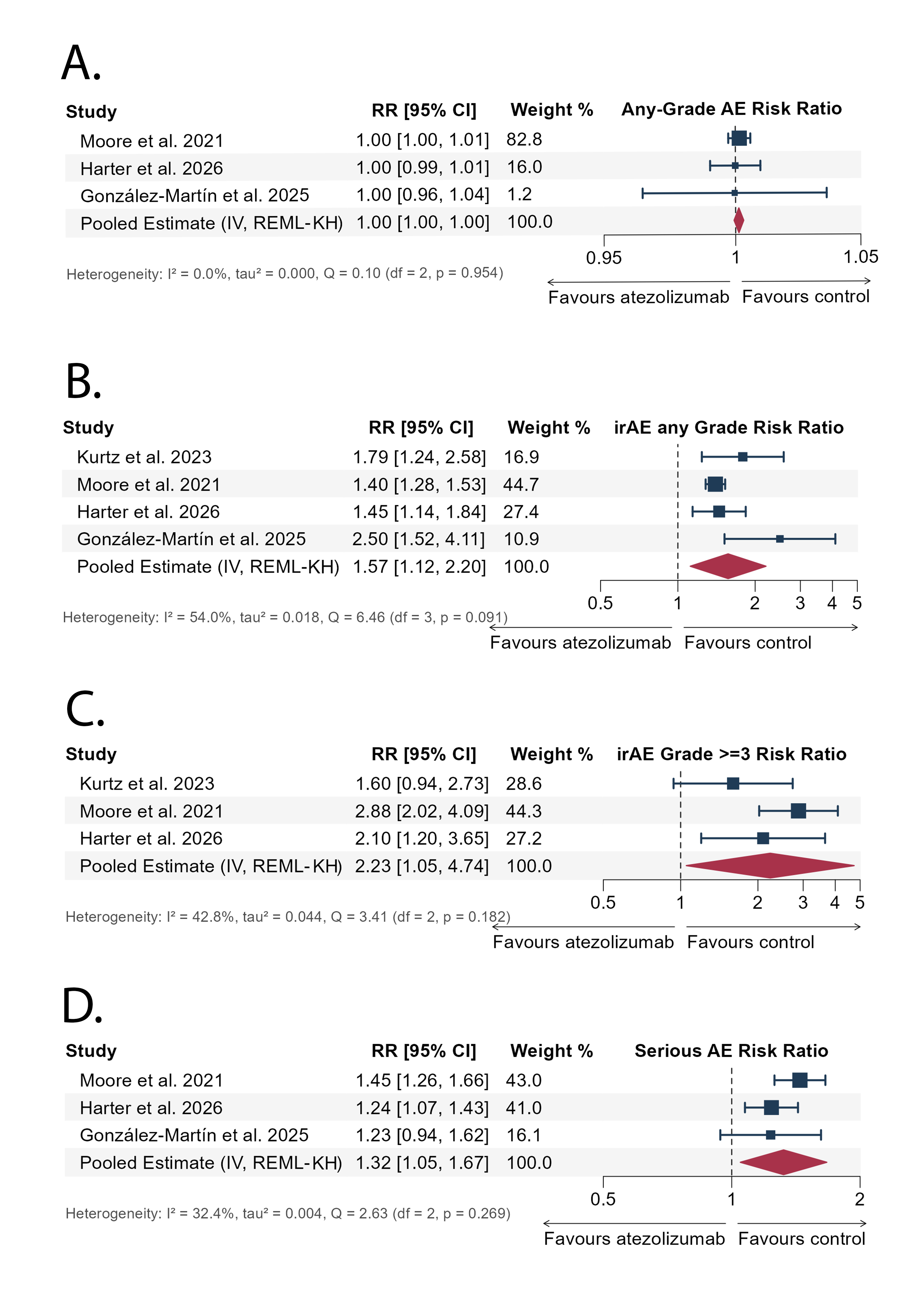
Any-grade AEs were near-universal in both arms and did not differ, with a pooled RR of 1.00 (95% CI 1.00 to 1.00; three comparisons) and no heterogeneity (I² = 0.0%, Q p = 0.95). Serious adverse events were more frequent with atezolizumab, with a pooled RR of 1.32 (95% CI 1.05 to 1.67, p = 0.036; three comparisons) and low heterogeneity (I² = 32.4%, Q p = 0.27). Immune-related adverse events of any grade were increased
(RR 1.57, 95% CI 1.12 to 2.20, p = 0.024; four comparisons), with moderate heterogeneity in the magnitude of effect (I² = 54.0%, Q p = 0.09) and a stable estimate on leave-one-out analysis (1.42 to 1.75). Grade ≥3 irAEs were approximately doubled (RR 2.23, 95% CI 1.05 to 4.74, p = 0.044; three comparisons), with moderate heterogeneity (I² = 42.8%, Q p = 0.18); the wide interval reflects the small number of events (Figure 5).
Pooled single-arm incidence of key safety events in the atezolizumab arm ranged from 1.8% (95% CI 1.1 to 2.9) for grade 5 or treatment-related deaths to 66.5% (95% CI 53.0 to 77.8) for grade ≥3 AEs, with several outcomes showing substantial between-trial heterogeneity (Table 5).
|
Safety outcome |
Studies, k (arms) |
Events / total |
Primary GLMM, % (95% CI) |
Leave-one-out range, % |
I², % |
95% prediction interval, % |
|
Grade ≥3 AE |
10 (11) |
1312 / 1699 |
66.5 (53.0–77.8) |
62.0–68.8 |
93.7 |
21.4–93.6 |
|
TRAE, grade ≥3 |
8 (8) |
851 / 1625 |
39.5 (22.2–59.8) |
34.2–46.1 |
97.7 |
3.4–92.3 |
|
Serious AE (SAE) |
6 (6) |
572 / 1180 |
38.5 (24.8–54.3) |
34.4–45.6 |
93.9 |
7.2–83.4 |
|
AE-related discontinuation |
9 (10) |
295 / 1473 |
11.6 (6.6–19.7) |
10.0–14.5 |
89.6 |
1.9–47.5 |
|
Grade 5 / treatment-related death |
12 (14) |
33 / 1738 |
1.8 (1.1–2.9) |
1.4–1.9 |
18.4 |
0.7–4.2 |
|
Abbreviations: AE, adverse event; CI, confidence interval; GLMM, generalized linear mixed model; SAE, serious adverse event; TRAE, treatment-related adverse event. |
||||||
Risk of bias and certainty of evidence
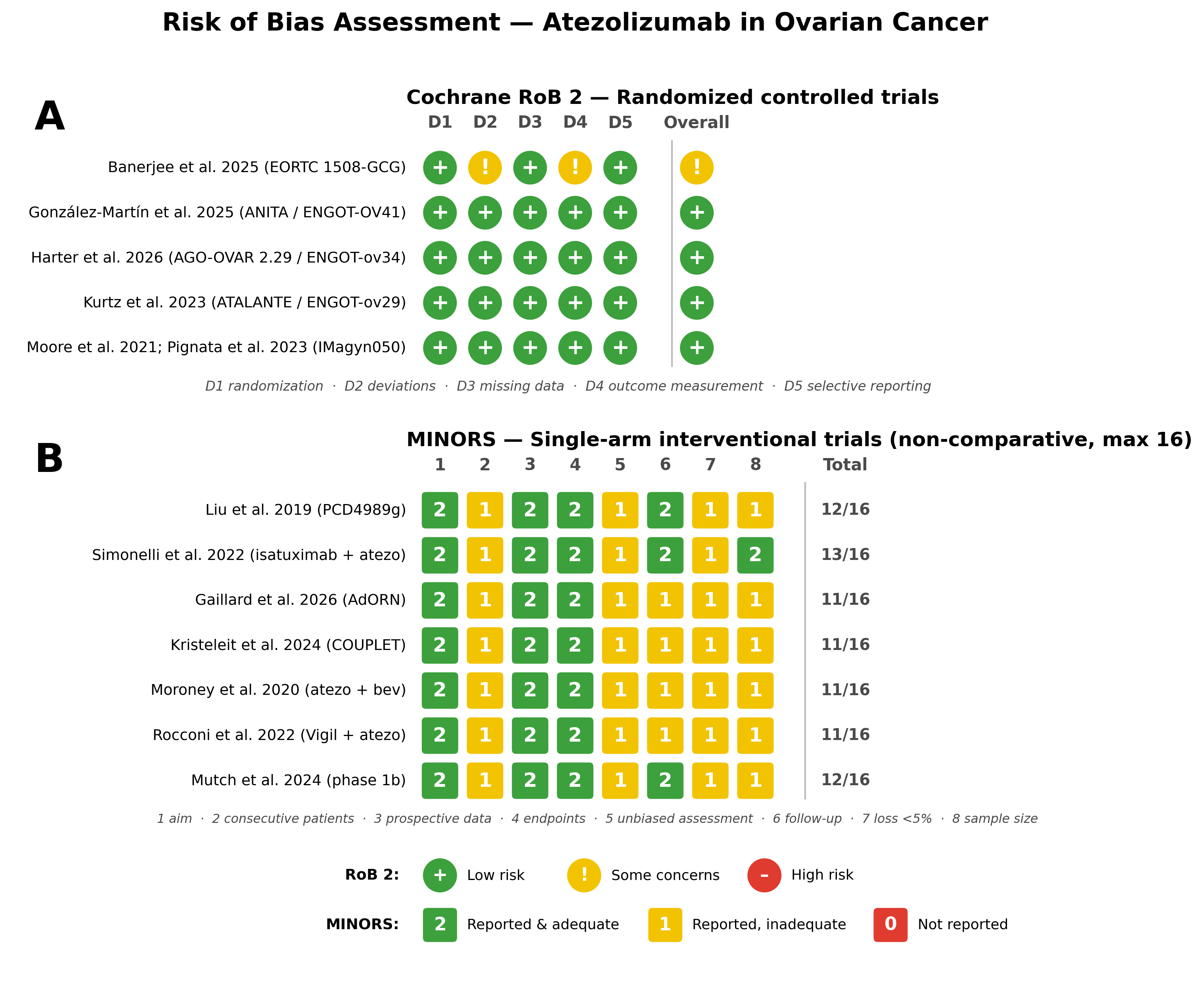
The five randomized trials contributing comparative data were appraised with RoB 2. Four were rated overall low risk and one some concerns, driven by its open-label design and investigator-assessed outcome. The seven data sets analyzed as single arms (the five single-arm trials and the two randomized trials that contributed single-arm data only) were assessed with MINORS, scoring 11 to 13 of 16, with deductions concentrated on consecutive inclusion, independent endpoint assessment, loss to follow-up, and prospective sample-size calculation (Figure 6).
Certainty of evidence was assessed across 14 outcomes. Of the nine comparative outcomes from randomized controlled trials, five were rated high certainty, three moderate, and one very low. Downgrading was driven solely by inconsistency and imprecision; risk of bias, and indirectness raised no concerns. The five single-arm pooled proportions began at low certainty and, except treatment-related death, were downgraded to very low for inconsistency, and two of these were downgraded for imprecision as well (Table 6).
|
Certainty assessment |
№ patients |
Effect |
Certainty |
Impor- |
||||||||
|
Outcome |
No studies |
Study |
Analysis model |
Risk of |
Incon- |
Indirect- |
Impre- |
Other consi- |
||||
|
Progression-free survival |
5 |
RCT / High |
IV random-effects |
not serious |
not serious |
not serious |
not serious |
none |
1,562 / 1,364 |
HR 0.88 (0.83–0.93) |
⨁⨁⨁⨁ |
Critical |
|
Progression-free survival |
4 |
RCT |
IV random-effects |
not serious |
not serious |
not serious |
not serious |
none |
686 / 611 |
HR 0.82 (0.76–0.89) |
⨁⨁⨁⨁ |
Critical |
|
Overall survival |
4 |
RCT / High |
IV random-effects |
not serious |
not serious |
not serious |
not serious |
none |
1,355 / 1,155 |
HR 0.86 (0.78–0.96) |
⨁⨁⨁⨁ |
Critical |
|
Overall survival |
3 |
RCT |
IV random-effects |
not serious |
not serious |
not serious |
serious |
none |
610 / 538 |
HR 0.83 (0.71–0.98) |
⨁⨁⨁◯ |
Critical |
|
Comparative efficacy — response (risk ratio) |
||||||||||||
|
Objective response rate |
5 |
RCT / High |
IV random-effects |
not serious |
very serious |
not serious |
serious |
none |
1,155 / 933 |
RR 0.88 (0.52–1.49) |
⨁◯◯◯ |
Important |
|
Comparative safety (risk ratios) |
||||||||||||
|
Any-grade adverse event |
3 |
RCT / High |
IV random-effects |
not serious |
not serious |
not serious |
not serious |
none |
1,130 / 1,139 |
RR 1.00 (1.00–1.00) |
⨁⨁⨁⨁ |
Important |
|
Serious adverse event (vs comparator) |
3 |
RCT / High |
IV random-effects |
not serious |
not serious |
not serious |
not serious |
none |
1,130 / 1,139 |
RR 1.32 (1.05–1.67) |
⨁⨁⨁⨁ |
Critical |
|
Immune-related AE, any grade |
4 |
RCT / High |
IV random-effects |
not serious |
serious |
not serious |
not serious |
none |
1,538 / 1,340 |
RR 1.57 (1.12–2.20) |
⨁⨁⨁◯ |
Important |
|
Immune-related AE, grade ≥3 |
3 |
RCT / High |
IV random-effects |
not serious |
not serious |
not serious |
serious |
none |
1,331 / 1,131 |
RR 2.23 (1.05–4.74) |
⨁⨁⨁◯ |
Critical |
|
Single-arm safety — pooled proportions of the atezolizumab arm |
||||||||||||
|
Grade ≥3 AE (pooled proportion) |
10 |
Single-arm / Low |
Binomial GLMM |
not serious |
Serious |
not serious |
not serious |
none |
1,699 / – |
66.5% (53.0–77.8) |
⨁◯◯◯ |
Important |
|
Treatment-related AE, grade ≥3 (pooled proportion) |
8 |
Single-arm / Low |
Binomial GLMM |
not serious |
very serious |
not serious |
Serious |
none |
1,625 / – |
39.5% (22.2–59.8) |
⨁◯◯◯ |
Important |
|
Serious AE (pooled proportion) |
6 |
Single-arm / Low |
Binomial GLMM |
not serious |
very serious |
not serious |
not serious |
none |
1,180 / – |
38.5% (24.8–54.3) |
⨁◯◯◯ |
Critical |
|
AE-related treatment discontinuation (pooled proportion) |
9 |
Single-arm / Low |
Binomial GLMM |
not serious |
very serious |
not serious |
Serious |
none |
1,473 / – |
11.6% (6.6–19.7) |
⨁◯◯◯ |
Important |
|
Grade 5 / treatment-related death (pooled proportion) |
12 |
Single-arm / Low |
Binomial GLMM |
not serious |
not serious |
not serious |
not serious |
none |
1,738 / – |
1.8% (1.1–2.9) |
⨁⨁◯◯ |
Critical |
|
Certainty (GRADE): ⨁⨁⨁⨁ High · ⨁⨁⨁◯ Moderate · ⨁⨁◯◯ Low · ⨁◯◯◯ Very Low. Each domain is rated not serious / serious (−1) / very serious (−2). RCT outcomes start High; single-arm pooled proportions start Low. Abbreviations: AE, adverse event; CI, confidence interval; GLMM, generalized linear mixed model; GRADE, Grading of Recommendations Assessment, Development and Evaluation; HR, hazard ratio; IV, inverse variance; PD-L1, programmed death-ligand 1; RCT, randomized controlled trial; REML, restricted maximum likelihood; RR, risk ratio |
||||||||||||
Discussion
Standard first-line management of OC pairs primary debulking surgery with paclitaxel and carboplatin, reserving neoadjuvant chemotherapy and interval debulking for patients unfit for upfront resection [4]. Maintenance bevacizumab and PARP inhibitors followed, though their benefit concentrates in BRCA1/2-mutated and homologous recombination-deficient tumors [10]. PD-1/PD-L1 inhibitors occupy a biomarker-selected niche in mismatch repair-deficient, microsatellite instability-high, or high tumor mutational burden disease [2]. Atezolizumab is given with bevacizumab or chemotherapy rather than alone, since monotherapy produces limited activity in this immunologically cold tumor, where low mutational burden and abundant regulatory T cells and tumor-associated macrophages constrain T-cell responses [3]. This carries appreciable toxicity, with treatment-related events in roughly 71% of patients and irAE in 29% in recurrent disease [2], dominated by grade 1-2 thyroid dysfunction, fatigue, nausea, and fever [11], and all-grade hypertension near 31% when bevacizumab is added [7].
The present meta-analysis found that atezolizumab lowered the hazard of progression (HR 0.88, 95% CI 0.83 to 0.93) and death (HR 0.86, 95% CI 0.78 to 0.96), each with zero heterogeneity. The individual phase III trials (IMagyn050, ATALANTE) were sized for larger effects, so their concordant sub-threshold estimates missed significance alone; pooling resolves a survival benefit no single trial could establish. Class-level reviews returned overall nulls because they combined pharmacologically distinct antibodies and mixed monotherapy with combination regimens. Vida et al. pooled ten randomized trials and found no overall effect (PFS HR 0.98, 95% CI 0.85 to 1.12; I² = 67%) [10], and Ahmadi et al. reported survival intervals crossing unity (PFS HR 0.82; OS HR 0.85) [3]. Ahmadi's network meta-analysis nonetheless ranked checkpoint inhibitor plus chemotherapy combinations among the highest for survival [3]. The current analysis extends that class-level signal to atezolizumab specifically, converting a ranking of mixed agents into a homogeneous, significant estimate for a single antibody given on a chemotherapy or bevacizumab backbone.
Expression of PD-L1 has been proposed as a predictive biomarker for checkpoint blockade in ovarian cancer. The evidence regarding this matter is mixed: one meta-analysis reported a significant PFS benefit with PD-1/PD-L1 inhibitors plus chemotherapy in PD-L1-positive patients (HR 0.65, 95% CI 0.46-0.92) [3], while a separate pooled analysis of ten randomized trials across multiple anti-PD-1 and anti-PD-L1 agents found no significant PFS benefit in this subgroup (HR 0.91, 95% CI 0.79-1.04, I² = 64.2%) [10]. That pooled analysis attributed its null result largely to inconsistent PD-L1 thresholds and scoring platforms across the included trials, most of which relied on an arbitrary 1% cutoff without assay harmonization. The problem went beyond the cutoff value itself; an exploratory 5% PD-L1 threshold suggested possible benefit in IMagyn050 (HR=0.64, 95% CI 0.43-0.96) [4], but this signal was not replicated in the FIRST trial despite using the same 5% cutoff, because the two trials scored PD-L1 differently (tumor area proportion versus immune cell score) [10]. The PD-L1-positive findings in the current analysis (PFS HR 0.82, 95% CI 0.76-0.89; OS HR 0.83, 95% CI 0.71-0.98), both without heterogeneity, are more in line with a differential benefit in PD-L1-positive patients than with the null pooled estimate described above. This remains hypothesis-generating, as no formal interaction testing was performed, and confirmation would require standardized PD-L1 assays.
The survival benefit did not extend to ORR in this review, which showed no difference between arms (RR 0.88, 95% CI 0.52 to 1.49). This dissociation may reflect checkpoint blockade acting on the durability of disease control rather than tumor shrinkage, consistent with the modest single-agent activity reported in prior studies, where pooled monotherapy ORR was only 6.7% versus 36% and 30% for combinations with chemotherapy and anti-angiogenic agents, respectively [2]. Prior studies also report that response varies by treatment line and platinum status: ORR was as low as 11.6% in heavily pretreated recurrent disease, and as high as 44% with select combination regimens in platinum-resistant patients [1,3]. This variability likely contributes to the heterogeneity in the pooled ORR estimate (I² = 92.3%).
This review demonstrated identical any-grade AEs between arms (RR 1.00), but atezolizumab raised SAEs (RR 1.32, 95% CI 1.05 to 1.67), any-grade irAE (RR 1.57, 95% CI 1.12 to 2.20), and grade ≥3 irAE (RR 2.23, 95% CI 1.05 to 4.74). The excess is immune-mediated and consistent with a meta-analysis of atezolizumab plus bevacizumab that reported 14.1% grade 3 hypertension [7]. A modest survival gain comes at roughly double the risk of a high-grade immune event.
Grade ≥3 rates are lower for less intensive regimens, at 32% for single-arm pembrolizumab [11], 15% in endometrial cancer [26], and 5.4% for tarlatamab in small-cell lung cancer [8]. Against that range, the atezolizumab arm in the present analysis reached 66.5% for grade ≥3 AEs, with 38.5% for SAEs, 11.6% for treatment discontinuation, and 1.8% for treatment-related death. That ordering places the excess with the chemotherapy and bevacizumab backbone rather than the antibody. Fatal toxicity stayed below 2%, and discontinuation near 12% marks the practical limit on tolerability.
Unlike prior reviews, which appraised study quality but did not grade the certainty of their pooled estimates [1,11], the present analysis paired GRADE with RoB 2 and MINORS assessment, allowing the survival benefit to be reported with an explicit certainty rating
Our meta-analysis has several limitations. First, the survival estimates mainly rest on combination trials, so atezolizumab cannot be separated from its backbone. Second, a few large phase III trials dominate the pooled result, so the low heterogeneity may reflect their weight rather than broad replication. Third, OS was immature in several trials and may attenuate with longer follow-up. Finally, enrollment was largely restricted to good performance status (ECOG 0 to 1, 97.4%), limiting generalizability to frail patients common in recurrent disease.
Conclusion
Adding atezolizumab to a chemotherapy or bevacizumab backbone in stage 3 and 4 ovarian cancer was associated with a small survival benefit, driven by delayed progression rather than tumor regression, at the cost of increased immune-related toxicity. As the effect was modest and inseparable from its backbone, current evidence may not support routine use.
Declaration
Conflicts of interest: The authors have no conflicts of interest to disclose.
Ethical approval: Not applicable, as systematic reviews do not require ethical approval.
Patient consent (participation and publication): Not applicable.
Funding: The present review received no financial support.
Acknowledgments: None to be declared.
Authors' contributions: R.H.A. was responsible for conceptualization, methodology, and validation. S.S.O. contributed to validation and writing – review & editing. S.M.A. provided supervision and contributed to methodology. S.H.M. and K.K.M. performed investigations and contributed to writing – review & editing. M.Q.M. and Y.M.M. contributed resources and assisted with writing – review & editing. S.H.K. contributed to data curation and writing – review & editing. H.A.N. handled data curation, validation, and writing – review & editing. A.G.H. contributed to validation and writing – review & editing. Z.T.H. wrote the original draft, conducted formal analysis, performed investigations, contributed to methodology, and performed visualization. D.D.M. contributed to writing the original draft and formal analysis. M.J.M., S.S.R., and F.M.Q. contributed to writing – review & editing. B.A.A. wrote the original draft and contributed to methodology. All authors read and approved the final manuscript.
Use of AI: During the preparation of this work, the authors used Claude Opus 4.8 (Anthropic) to assist with text drafting and language editing, code development in R, and figure generation. After using this tool, the authors reviewed and edited the content as necessary and take full responsibility for the content of the publication.
Data availability statement: The datasets used and/or analyzed during the current study are available from the corresponding author upon reasonable request.
References
- Chen Y, Liu X, Hu Y, Xia L. Efficacy and safety of PD-1/PD-L1 immune checkpoint inhibitors in the treatment of recurrent ovarian cancer: A systematic review and meta-analysis. Medicine. 2024;103(18): e38019. doi:10.1097/MD.0000000000038019
- Zeng S, Liu D, Yu Y, Zou L, Jin X, Liu B et al. Efficacy and safety of PD-1/PD-L1 inhibitors in the treatment of recurrent and refractory ovarian cancer: A systematic review and a meta-analysis. Frontiers in Pharmacology. 2023;14:1111061. doi:10.3389/fphar.2023.1111061
- Ahmadi N, Kadi C, Benlamari M, Gaouzi Z, El Ouali EM, Bouziane A et al. Efficacy of PD-1/PDL-1 inhibitors for ovarian cancer: a systematic review and network meta-analysis. Future Oncology. 2025;21(20):2637–2647. doi:10.1080/14796694.2025.2530378
- Gadducci A, Cosio S. Randomized Clinical Trials and Real World Prospective Observational Studies on Bevacizumab, PARP Inhibitors, and Immune Checkpoint Inhibitors in the First-Line Treatment of Advanced Ovarian Carcinoma: A Critical Review. Anticancer Research. 2021;41(10):4673–4685. doi:10.21873/anticanres.15281
- Ali RM, Kakamad FH, Abdullah HO, Abdulla SH, Ahmed SF, Hama Amin BJ et al. Pembrolizumab (Anti-PD-1) Immunotherapy in Malignant Pleural Mesothelioma: A Systematic Review of the Current Literature. Barw Medical Journal. 2023. doi:10.58742/bmj.v1i2.34
- Ali RM, Omar SS, Abdalla SH, Fattah FH, Hamalaw SR, Hamasalih HM et al. Pembrolizumab and Sarcoma: A meta-analysis. Judi Clinical Journal. 2025;1(1):51–62. doi:10.70955/JCJ.2025.6
- Jiang L, Tan X, Li J, Li Y. Incidence and Risk of Hypertension in Cancer Patients Treated With Atezolizumab and Bevacizumab: A Systematic Review and Meta-Analysis. Frontiers in Oncology. 2021;11:726008. doi:10.3389/fonc.2021.726008
- Ali RM, Mohammed KK, Ahmed SM, Najar KA, Mustafa MQ, Hama ZK et al. Small Cell Lung Cancer and Tarlatamab: A Meta-Analysis of Clinical Trials. Barw Medical Journal. 2025;3(5):42–51. doi:10.58742/bmj.v4i1.216
- Abdalla B, Ali R, Kakamad F, Ahmed H, Ali R, Abdullah A et al. Role of dasatinib in the management of lung cancer: A meta-analysis of clinical trials. Biomedical Reports. 2025;22(3):51. doi:10.3892/br.2025.1929
- Vida R, Bartoletti M, Montico M, Pignata S, Baldassarre G, Ditto A et al. Immunotherapy with anti-PD-1 or PD-L1 in advanced ovarian cancer: A meta-analysis of randomized trials. Cancer Treatment Reviews. 2026;144:103094. doi:10.1016/j.ctrv.2026.103094
- Mi X, Tan L, Lin T, Yang Y, Liu H, Tuo F. Efficacy and safety of pembrolizumab for the treatment of advanced or recurrent ovarian cancer: a meta-analysis based on single-arm studies. Frontiers in Immunology. 2025;16:1662455. doi:10.3389/fimmu.2025.1662455
- Kakamad FH, Mohammed SH, Abdalla BA, Hussein DA, Hammood ZD, Kakamad SH et al. Non-Recommended Publishing Lists: Strategies for Detecting Deceitful Journals. Barw Medical Journal. 2026:33–41. doi:10.58742/bmj.v4i1.227
- Banerjee S, Ghisoni E, Wolfer A, Ottevanger PB, Le Scodan R, Sarivalasis A et al. Bevacizumab, Atezolizumab, and Acetylsalicylic Acid in Recurrent, Platinum-Resistant Ovarian Cancer: The EORTC 1508-GCG Phase II Study. Clinical Cancer Research. 2025;31(11):2145–2153. doi:10.1158/1078-0432.CCR-24-3368
- Gaillard S, Parker J, Broadwater G, Duska L, Knochenhauer H, Ring K et al. Atezolizumab in combination with neoadjuvant chemotherapy and interval cytoreductive surgery for patients with newly diagnosed advanced-stage epithelial ovarian cancer: the AdORN study. Gynecologic Oncology. 2026;210:208–216. doi:10.1016/j.ygyno.2026.06.003
- González-Martín A, Rubio MJ, Heitz F, Depont Christensen R, Colombo N, Van Gorp T et al. Atezolizumab Combined With Platinum and Maintenance Niraparib for Recurrent Ovarian Cancer With a Platinum-Free Interval >6 Months: ENGOT-OV41/GEICO 69-O/ANITA Phase III Trial. Journal of Clinical Oncology. 2024;42(36):4294–4304. doi:10.1200/JCO.24.00668
- Harter P, Marmé F, Redondo A, Reuss A, Lindemann K, Kurzeder C et al. Atezolizumab With Bevacizumab and Nonplatinum Chemotherapy for Recurrent Ovarian Cancer: Final Results From the Placebo-Controlled AGO-OVAR 2.29/ENGOT-ov34 Phase III Trial. Journal of Clinical Oncology. 2026;44(2):103–116. doi:10.1200/JCO-25-01210
- Kristeleit R, Leary A, Oaknin A, Redondo A, George A, Chui S et al. PARP inhibition with rucaparib alone followed by combination with atezolizumab: Phase Ib COUPLET clinical study in advanced gynaecological and triple-negative breast cancers. British Journal of Cancer. 2024;131(5):820–831. doi:10.1038/s41416-024-02776-7
- Kurtz J-E, Pujade-Lauraine E, Oaknin A, Belin L, Leitner K, Cibula D et al. Atezolizumab Combined With Bevacizumab and Platinum-Based Therapy for Platinum-Sensitive Ovarian Cancer: Placebo-Controlled Randomized Phase III ATALANTE/ENGOT-ov29 Trial. Journal of Clinical Oncology. 2023;41(30):4768–4778. doi:10.1200/JCO.23.00529
- Liu JF, Gordon M, Veneris J, Braiteh F, Balmanoukian A, Eder JP et al. Safety, clinical activity and biomarker assessments of atezolizumab from a Phase I study in advanced/recurrent ovarian and uterine cancers. Gynecologic Oncology. 2019;154(2):314–322. doi:10.1016/j.ygyno.2019.05.021
- Moore KN, Bookman M, Sehouli J, Miller A, Anderson C, Scambia G et al. Atezolizumab, Bevacizumab, and Chemotherapy for Newly Diagnosed Stage III or IV Ovarian Cancer: Placebo-Controlled Randomized Phase III Trial (IMagyn050/GOG 3015/ENGOT-OV39). Journal of Clinical Oncology. 2021;39(17):1842–1855. doi:10.1200/JCO.21.00306
- Pignata S, Bookman M, Sehouli J, Miller A, Penson RT, Taskiran C et al. Overall survival and patient-reported outcome results from the placebo-controlled randomized phase III IMagyn050/GOG 3015/ENGOT-OV39 trial of atezolizumab for newly diagnosed stage III/IV ovarian cancer. Gynecologic Oncology. 2023; 177:20–31. doi: 10.1016/j.ygyno.2023.06.018
- Moroney JW, Powderly J, Lieu CH, Bendell JC, Eckhardt SG, Chang C-W et al. Safety and Clinical Activity of Atezolizumab Plus Bevacizumab in Patients with Ovarian Cancer: A Phase Ib Study. Clinical Cancer Research. 2020;26(21):5631–5637. doi:10.1158/1078-0432.CCR-20-0477
- Mutch D, Voulgari A, Chen X, Bradley WH, Oaknin A, Perez Fidalgo JA et al. Primary results and characterization of patients with exceptional outcomes in a phase 1b study combining PARP and MEK inhibition, with or without anti–PD‐L1, for BRCA wild‐type, platinum‐sensitive, recurrent ovarian cancer. Cancer. 2024;130(11):1940–1951. doi:10.1002/cncr.35222
- Rocconi RP, Stevens EE, Bottsford-Miller JN, Ghamande SA, Elder J, DeMars LL et al. Proof of principle study of sequential combination atezolizumab and Vigil in relapsed ovarian cancer. Cancer Gene Therapy. 2022;29(3–4):369–382. doi:10.1038/s41417-021-00317-5
- Simonelli M, Garralda E, Eskens F, Gil-Martin M, Yen C-J, Obermannova R et al. Isatuximab plus atezolizumab in patients with advanced solid tumors: results from a phase I/II, open-label, multicenter study. ESMO Open. 2022;7(5):100562. doi:10.1016/j.esmoop.2022.100562
- Wan X, Huang J, Huang L, Wang Y, Fu Y, Jin X et al. Effectiveness and safety of PD-1/PD-L1 inhibitors monotherapy in patients with endometrial cancer. Discover Oncology. 2024;15(1):168. doi:10.1007/s12672-024-01033-w

This work is licensed under a Creative Commons Attribution 4.0 International License.